
Welcome back for part two of my Tribeca 2026 coverage!
**********
I can rarely stay away from documentaries at film festivals, and Tribeca 2026 was no exception. Nearly half of the thirty titles I saw at the fest were docs. Some were stronger than others, to be sure, but there were no out-and-out clunkers in the bunch. I began and ended my documentary adventures at Tribeca 2026 with stories about critics/artists.
Crocodile is a fly-on-the-wall study of a Nigerian filmmaking collective known as The Critics. This group of young men began making guerilla-style DIY movies with their iPhones in their teenage years. They grew such an impressive following on YouTube during the 2010s that, as we see in the documentary, Hollywood maestro J.J. Abrams sends the young directors thousands of dollars’ worth of equipment and holds a conference call with them when it arrives.
Over a decade into their careers of examining the poverty, deprivation, and hope of their native Nigeria through a bravura command of the sci-fi genre, director Pietra Brettkelly teamed up with The Critics in 2019 to document their story.
Through Crocodile – the title is an homage to the nickname of the city where The Critics are based – we get to know these guys and their hopes and dreams of becoming professional filmmakers against staggering odds. Brettkelly even documents the announcement and fallout of one of The Critics members confessing to sexually abusing one of his fellow teammates. We also get to see the young men travel to Germany for a display of their work at the Frankfurt MoMA, but only after someone at the museum cluelessly asks them if they’ve ever had pizza.
Through delirious highs and devastating lows, what stuck with me about Crocodile is the indomitability of the human spirit. No matter how bad conditions may get for people, we have an innate ability to hope that things will get better in the future and to work towards making that happen. For The Critics, a major component of nurturing that hope is through making art.
**********
The universe must have sensed that I was riding high on the optimism of Crocodile and that I needed an adjustment. Later in the same day, I screened another documentary with the provocative title How to Feed a Dictator by director Andrew Neel that left me much more conflicted about the human condition.
Within Dictator, Neel interviews the personal chefs for some of the most notorious totalitarian monsters of the twentieth century. The film includes discussions with the cooks for Saddam Hussein (masgouf, a grilled carp dish, was a staple), Idi Amin (who once jokingly denied rumors of cannibalism because, he said, human flesh was “too salty” for his taste), Pol Pot (whose chef we watch prepare a posthumous meal for and leave as a tribute at his grave site), Augusto Pinochet (whose inner circle dined on extravagant banquets while the Chilean people were tortured and murdered), and Kim Jong-il (a pizza fanatic who imported a chef from Italy to make precision pies while starving his own people).
I’m not breaking any ground by suggesting – as Hannah Arendt did decades ago – that the most horrifying quality of this kind of evil lies in its banality, its triviality. These dictators sometimes meted out murder on a whim. How to Feed a Dictator probes the banality of evil for people one step removed from the actual atrocities. These professional chefs had to master one skill in addition to cooking the perfect meal. They had to be professionals at not knowing what was happening around them.
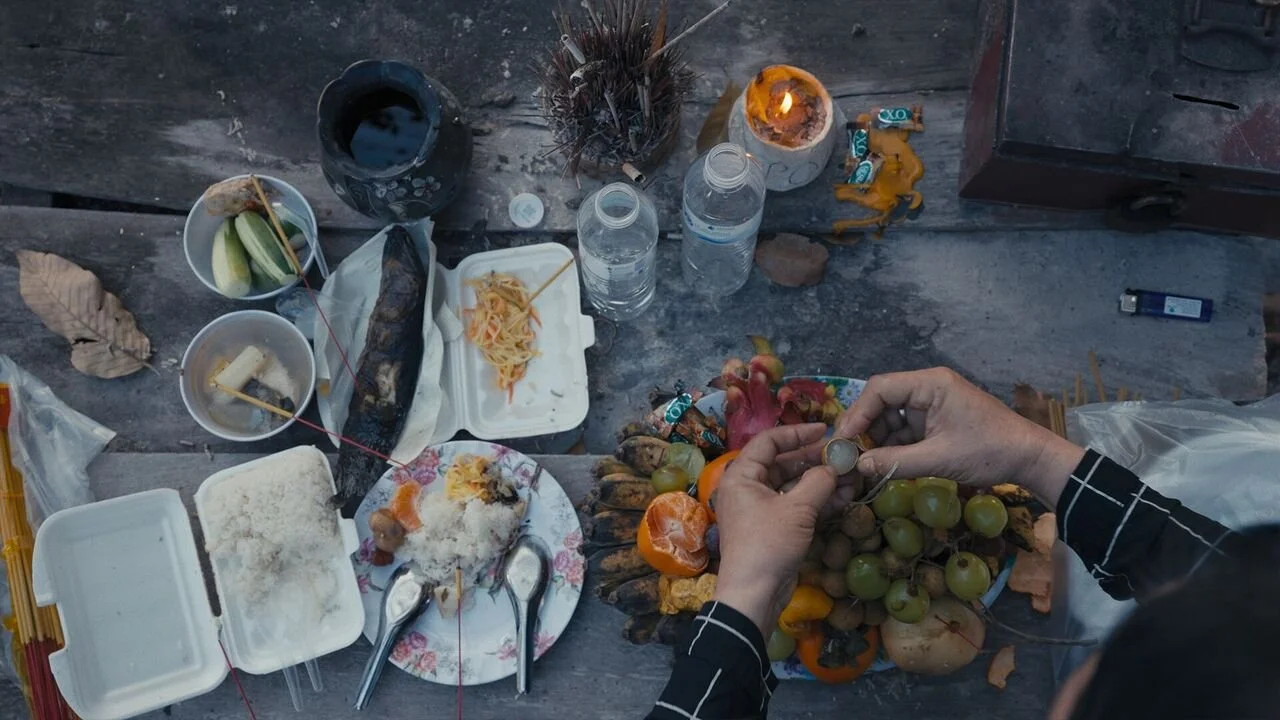
A still from How to Feed a Dictator.
The chef for Pol Pot talks lovingly about how the leader paid for her wedding and gave her away during the ceremony. If the people of Cambodia were being starved, tortured, and murdered in the killing fields, well gosh, she didn’t know anything about it. The pizza expert serving Kim Jong-il should have known better, considering he lived in a free society before taking the job, and he found out exactly what he was in for when his passport was confiscated after arriving in North Korea.
Still worse are the few chefs Neel interviews who cosign everything their former employers did. The chef for Pinochet believes the military dictator saved Chile from communism, no matter how many people had to die as a result. Hussein’s former cook declares the man who ran “rape rooms” under his regime and deployed chemical weapons on his own people to be the “father of Iraq.” This particular chef requested that his identity be shielded due to fears of retribution from victims of Hussein.
The most disheartening thing to realize was that, whether the chefs agreed politically with their boss or were oblivious to what was happening around them, a great deal of violence and harm can be excused simply by saying, “the money’s good and I’m fine, so why should I care about anyone else?”
That’s the major project that any authoritarian system must work to sustain. If you’re in the in-group, everything is great, and the people in the out-group deserve to be punished. Any person who is being intellectually honest will acknowledge this is the exact framework in place under the current Trump regime here in the United States.
In the film’s most urgent warning to the US about our current situation, it’s impossible to hear of the deluded self-importance, naked lust for power, and disregard for the human dignity of others that these dictators espoused without thinking of Trump. I lost count during How to Feed a Dictator of the number of times a characteristic of one of these despots was described and I immediately thought to myself, “sounds like Trump.” Neel’s film, which is based on a 2020 book by Polish journalist Witold Szabłowski, serves as both a history lesson and a warning, if we’ll heed it.
**********
Another notable documentary I saw during Tribeca 2026 was American Zoo, which focuses on a petting zoo/nature center called the Catskill Game Farm that operated for close to three quarters of a century. This attraction, the first private zoo in America, gained a reputation as an all-American family vacation spot in the mid-to-late 20th century, especially among the Jewish population of the New York region.
Behind the scenes, however, was a secretive program to continue eugenics experiments on animals that was started under the Nazi regime during World War II. It turns out that the petting zoo was founded by a man who escaped Nazi Germany as a child. When this man brought his father to America, the father recommended to his son someone with the last name of Heck to oversee the breeding in the park.
American Zoo explores the history of the Hecks, and how the patriarch of the family was the eugenics expert for Hitler. This man, whose work his son was determined to continue at the Catskill Game Farm, had a lot of, quite frankly, insane beliefs about using “back breeding” to undo evolution for certain species of animal. The sick ideology of fascism is obsessed with returning to an idealized (and completely mythical) past glory, which is why Trump and his cult members will never shut up about making America great again.
This program at the Catskill Game Farm tried to resurrect an ancient form of wild horse known as the tarpan, as well as a primitive form of a bull that was much bigger and more aggressive than its modern equivalent. The nazis loved the idea of a primeval German forest filled with mythical creatures from a distant, grand past.
Fascists are also obsessed with the law of the jungle, where might makes right and domination of the weak is the most highly regarded use of power. That might have something to do with the fact that they know they can’t win most people over with their philosophy, so they must use violence to enforce their worldview. American Zoo is a shocking chronicle of the insanity of the nazi flavor of fascism, and how it can find a home abroad if it’s allowed to fester.
**********
Other documentaries I saw at Tribeca included IX XI, a unique exploration of the events of September 11, 2001 – a sobering thing to see in New York City – from the perspective of people who lived through the day. One is a TV news cameraman with the harrowing tale of getting footage at ground zero. Actor Griffin Dunne turns up to relate his own story of trying to track down his daughter in the madness. One interviewee was on the opposite coast, in California, during 9/11. She’s a Muslim, though, and her story is apropos because she describes how those around her completely changed how they interacted with her. Several of her “friends” even went so far as, she describes, to ask if she, who was a teenager at the time, was somehow involved with the terrorist attack simply because she was Muslim.
**********
Stealing Magic is an engrossing detective story about a group of magicians getting ripped off when pirate groups begin illegally offering the secrets of their magic online for a fraction of the price. The doc follows two determined magicians who go so far as to ship one of their magic books to the suspected pirate with an Apple airtag hidden inside in order to determine the location of the illicit operation. Teller of Penn & Teller is interviewed about how this kind of piracy can ruin careers, and the movie provides a primer on the history of magic and those trying to profit from it without putting in the hard work.
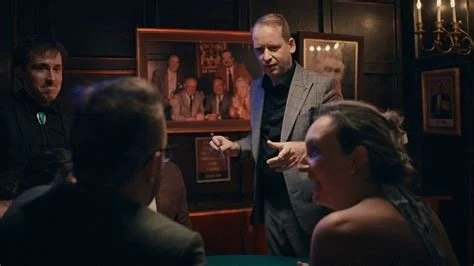
A still from Stealing Magic.
It was a happy accident that I saw Stealing Magic at all. I was running a little late on that day of the fest and missed my scheduled first movie. I consulted my guide and determined that I could slide into Stealing Magic without disrupting the rest of the day’s screenings. The movie I missed was another documentary, titled Mario, about the former Governor of New York state. Considering two of his children, Andrew and Chris Cuomo, are both nepo baby nightmares who are only invested in their own power and clout, I didn’t feel so bad about missing a documentary about the man who unleashed both of them on society.
**********
The A-Word: The Future of Aging offered a fascinating glimpse into the pharmaceutical battle to dramatically slow the phenomenon of aging in humans. One company uses dogs as a jumping off point, since man’s best friend ages in startlingly similar ways to humans. I was worried during the early minutes of The A-Word that the picture was some sort of commercial for Elizabeth Holmes-style hucksters who are using one of humanity’s biggest challenges to make a lot of money. I ultimately got the impression that these are scientists doing real work – one interview subject is a woman who discovered an aging gene in worms in the 1990s and essentially doubled her subjects’ life spans by turning it off.
The doc also offers interviews with several octogenarians about the struggles of aging. One man relates the story of his wife going upstairs to sleep one afternoon, only to die suddenly of a heart attack during her nap. He never got to say goodbye to the woman he was married to for decades. It’s a sobering reminder to say the important things to those you love, because you never know when they might be gone forever. As a tie-in to the rest of the film, this man has an aging dog, and he becomes a little unmoored when the prospect of losing the only companion he now has moves closer to becoming a reality.
**********
Odyssey (no, not that one) is an archival documentary that builds a narrative of the early days of NASA’s Apollo space program. Using 2,500 hours of contemporary news coverage and interviews with the astronauts and their families, we see the soaring triumphs and devastating failures of the Apollo mission as they played out in real time. I appreciated this film from director Avi Belkin — who directed the 2019 documentary Mike Wallace Is Here — mostly for its reminder that humans can do astonishing things when we come together for an admirable purpose. The deadly and devastating mistakes of the space program aside, Odyssey is competency porn in an age of nearly unbelievable stupidity and ineptitude from our so-called leaders.
**********
Check back tomorrow for part three of my Tribeca 2026 coverage!