**********
Welcome, at long last, to my coverage of Tribeca 2026. I meant to write and publish during the festival, but I hit a snag, so I had to adjust my strategy. I stayed with a high school friend and his husband on Long Island (Hi, Rex and Corey!), and for some reason, I was unable to successfully connect my laptop to their Wi-Fi network. I was able to connect my phone with zero issues.
That meant that I also couldn’t do any internet research on my laptop while writing. I had to look things up with my phone whenever I needed to confirm a bit of information; it was a real drag. I’m sure it was a weird, random setting on my laptop, but I simply didn’t have the wherewithal to figure it out at the time. I tried valiantly to write during the festival, but, unable to format and upload the coverage to my website, I eventually decided to simply enjoy the fest and worry about writing when I got home. Without further ado, let’s go back to early June together for my first out-of-state trip for a festival. Seems like it was only yesterday (insert Wayne and Garth doing the “doodly doo” sound)…
**********
New York City. NYC. The Big Apple. This country bumpkin’s first trip to one of the world’s cultural capitals, to cover Tribeca 2026, made real a city that I’ve been looking at on screen for nearly five decades.
After picking up my press badge at Spring Studios in Lower Manhattan, I quickly made my way the block-and-a-half south to the location that had been lodged in my brain since the minute I learned how close it was to Spring Studios.
At the southeast corner of N. Moore St. and Varick St. sits the iconic Ghostbusters fire house office that I first saw on VHS, the very first video rental transaction my family ever made after buying our first VCR in 1985 or thereabouts. It looks smaller in real life – because the magic of the movies makes everything larger than life – but it was a splendid way to kick off my sightseeing.
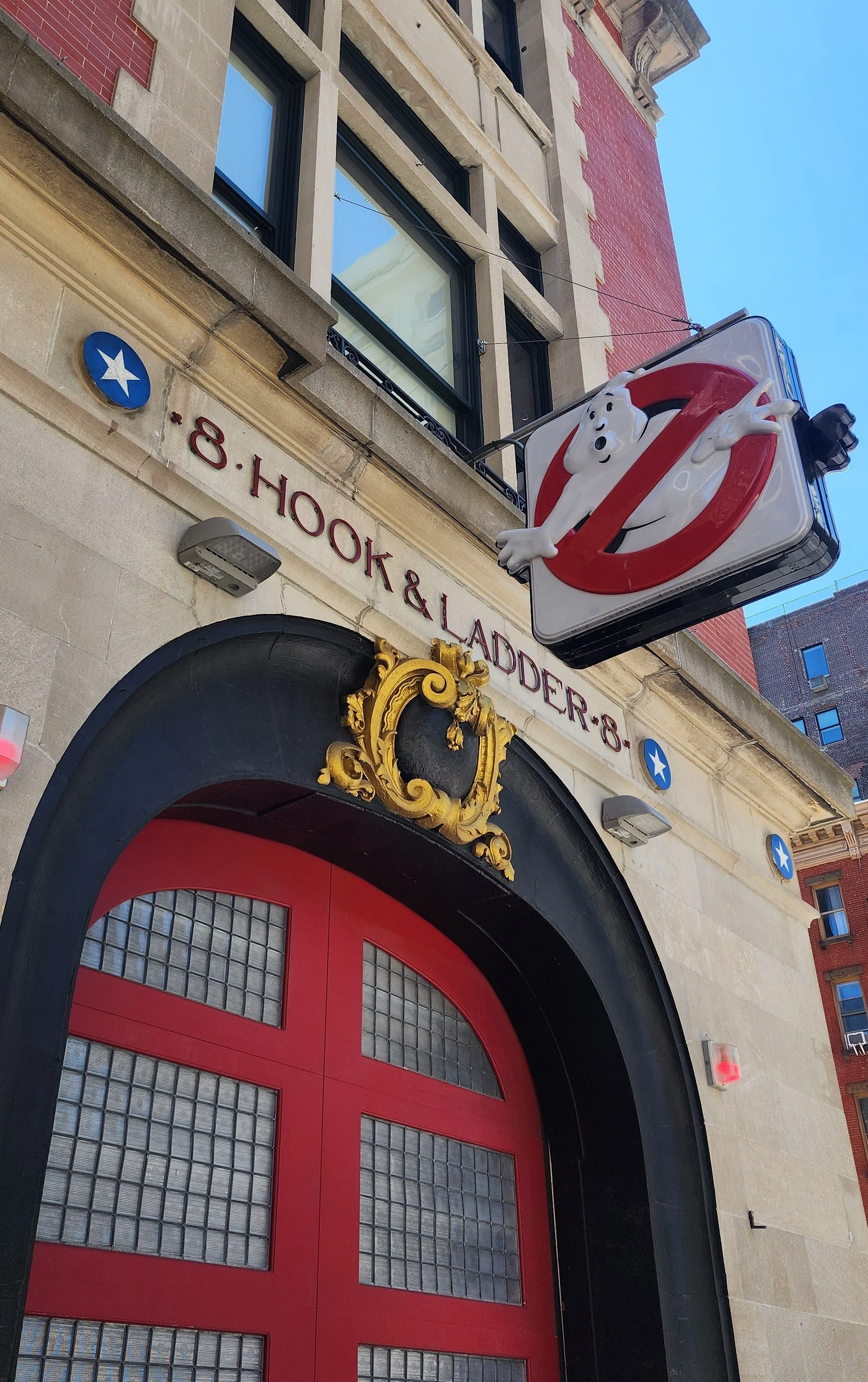
Who you gonna call? (photo by the author)
As I mentioned in my Tribeca 2026 teaser, I had booked my flight for a Tuesday arrival, not realizing at the time that the screenings I would be admitted to didn’t start until the following Thursday. That meant that Wednesday, after picking up my badge and visiting the Ghostbusters building, would be my best chance to explore the city.
And explore it I did. I explored it so hard – I walked from Penn Station to Battery Park, then, after a ride on the Staten Island Ferry, I walked back up to Penn Station after swinging by the Brooklyn Bridge – that I turned my feet into ground hamburger.
But, for that price, I got to see the Flatiron Building (one of my all-time favorite buildings), the 9/11 memorial (I skipped the museum; I feel like I have a pretty good handle on what happened that day), the Statue of Liberty (from a distance), and Chinatown, which I found myself walking through on the way to my last stop.
The last stop was the historic Five Points District, a 19th-century neighborhood which has since been subsumed by the aforementioned Chinatown. You’ll most likely recognize the Five Points as the setting for the bravura opening battle sequence from Martin Scorsese’s Gangs of New York.
I’m a movie nerd. So, as I walked around the area, mostly in Columbus Park, I slipped my earbuds in and queued up Shimmy She Wobble, the haunting song from the Gangs of New York soundtrack that precedes the opening battle. I imagined the scenes from that brutal fight sequence playing out in front of me as I listened to the song.
(I also queued up Brooklyn Heights, Pt. 1, one of the tracks that composer Howard Shore wrote for the movie, and noticed for the first time how much Shore’s scores for Gangs and Peter Jackson’s Lord of the Rings trilogy have in common.)
**********
I saw quite a few movies at Tribeca 2026 that were filmed on the streets of New York, which was fun, since I walked those same streets each day to get to the fest. The first of the four screenings I attended on day one turned out to take place on the opposite coast, in Los Angeles, by way of Kansas.
Gail Daughtry and the Celebrity Sex Pass was one of the titles I was most anticipating, but the jokes in David Wain’s newest comedy were more misses than hits. The director behind Wet Hot American Summer knows how to make me laugh. That movie is one of my all-time favorite comedies. I also howled at They Came Together, Wain’s 2014 sendup of the romcom subgenre.
The laugh lines in Gail Daughtry, by comparison, seem stale and threadbare. In a comedic, goofy counterpoint to something like David Lynch’s Wild at Heart, which was the late director’s most explicit reworking of his obsession, The Wizard of Oz, Gail Daughtry uses the familiar tale of Dorothy Gail’s trip over the rainbow to skewer the vapidity of Hollywood culture.
Hollywood is Oz, and Gail takes her fellow hairdresser – whose name is Otto, as in, an anagram for Toto – up on his offer to travel to La La Land from their home in Kansas to attend a hairdresser conference. She agrees to go when her fiancé gets the opportunity to use his celebrity sex pass after a book signing in their small Kansas town by a visiting TV star. (I won’t ruin the stunt casting, but the scene in which Gail discovers her betrothed in flagrante delicto falls completely flat.)
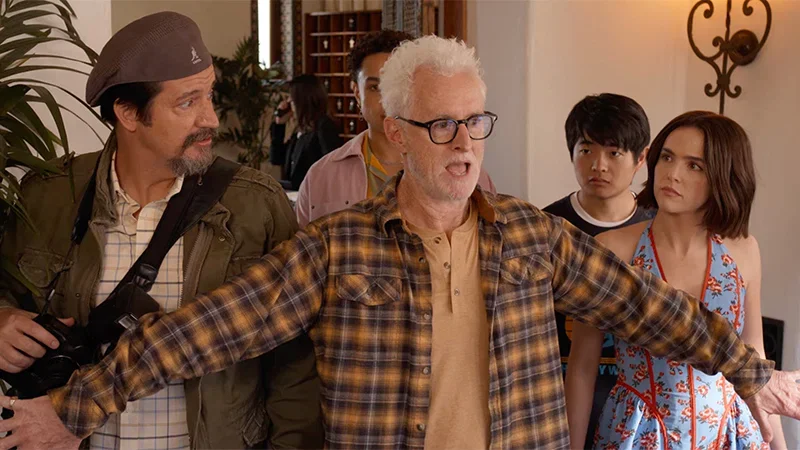
A still from Gail Daughtry and the Celebrity Sex Pass.
Gail is now on a mission to use her own pass to bed her most lusted after celebrity, Jon Hamm. Zany shenanigans ensue, including roping a down-and-out John Slattery into the scheme to find Hamm. There’s also a subplot involving a mix-up with two identical suitcases, one belonging to Gail, the other belonging to Ludovica, a mysterious and deadly Italian working on a plan of her own.
Sabrina Impacciatore, who appeared as Valentina in the second season of The White Lotus, plays Ludovica with zany abandon, but the material simply doesn’t give her much to work with. It was also jarring to see Impacciatore in the broadest possible comedy on the first day of the fest, then stumbling upon her again exactly a week later in In the Hand of Dante, the VERY serious new film from Julian Schnabel.
Early in Gail’s Hollywood odyssey, the receptionist at the hotel where she’s checking in gives her some inside tips about all the best Hollywood hot spots. He begins to circle locations on a map. If Gail wants gourmet cuisine, she should check out this place called McDonald’s. If she wants roasted ambrosia in coffee form, she should immediately get herself to this place called Starbucks. The joke is that LA has no cultural sophistication, and it’s a joke that Wain and co-screenwriter Ken Marino hit over and over again. There’s also a joke about how all the addresses in LA have a very long string of digits in the number.
Along with Paul Rudd – who shows up to literally wink at the camera – The State mainstays Joe Lo Truglio, the aforementioned Marino, Michael Ian Black, Kerri Kenney-Silver, and Thomas Lennon are all present and accounted for, but the writing of Gail Daughtry leaves them all in a movie that operates more in chuckle territory than guffaw.
**********
I love movies that take big swings. I am very affectionate towards Southland Tales, Richard Kelly’s absolutely bonkers follow up to his cult hit Donnie Darko. There’s something about a director going as maximalist as possible that I really admire.
In the Hand of Dante, from Julian Schnabel, the director of the stunning 2007 film The Diving Bell and the Butterfly, is an enormous swing, but one that doesn’t quite pay off because of its oppressively self-serious tone.
Based on the novel by Nick Tosches, who died in 2019 at the age of 69, Dante tells two stories. The first concerns a fictionalized version of Tosches set in 2001 in which the journalist, novelist, and poet becomes embroiled in a scheme to steal, authenticate, and sell for unimaginable riches a recently discovered complete draft of Dante’s Divine Comedy written in the poet’s own hand.
As the movie version of Tosches makes clear to Joe Black, the criminal mastermind who has learned of this discovery at the Vatican, this is the literary find of all of human history. There is no other sample of Dante’s writing known to exist, so this purported original manuscript can’t even be compared for authentication. Carbon dating to confirm that the writings were produced during the lifetime of the Italian Middle Ages poet is the only way to confirm that it might be authentic.
The self-serious tone I mentioned earlier comes barreling at you within the opening minutes of the picture. The term Mary Sue immediately came to my mind as the fictionalized version of Tosches manically describes to an acquaintance how intimately familiar he is with Dante’s Devine Comedy. After describing spending decades translating it, Tosches confesses to his friend – the one who ends up introducing him to Joe Black – that he feels like he wrote the poem himself. With a totally stable sense of ego like that, what could go wrong?
Meanwhile, interspersed with the black-and-white footage of Tosches helping mobsters steal a priceless work of art, are color passages depicting Dante in the 15th century struggling to birth that work of art. Based on the fictionalized version of himself that he created in his novel, I have to imagine that Tosches would have been overjoyed at Schnabel’s big-swing decision to cast Oscar Isaac as both Dante and Tosches.
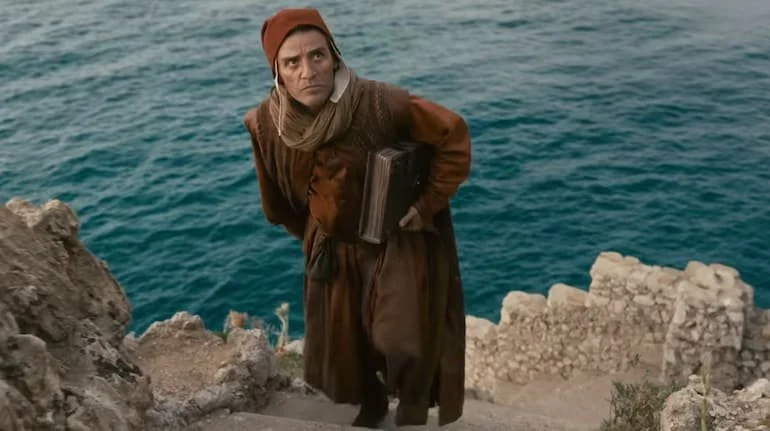
A still from In the Hand of Dante.
Gal Gadot also serves double duty as Gemma, Dante’s wife, and Giulietta, who is entangled with Tosches. The women of In the Hand of Dante don’t amount to much more than window dressing, however. Gadot’s characters are present simply to either push Dante towards the greatness to which he is destined, or to support Tosches as he (improbably) out-murders the mob thugs for whom he’s working.
After the screening, I saw Gadot catching some shots on Letterboxd for her terrible acting. While I’ll happily call out Gadot for being a supporter of the genocidal government and military of Israel, I think she’s a fine actor, and her performances in Dante are on par with the rest of the cast.
In the Hand of Dante briefly slips into camp territory when Tosches brings samples of the manuscript to an Italian expert on Dante who practically becomes orgasmic when she sees the pages and realizes what’s in front of her. Sabrina Impacciatore – from Gail Daughtry and the Celebrity Sex Pass – plays the ecstatic (and very sexually charged) moment so broadly that I laughed out loud.
Also in the “big-swing” category is Jason Momoa as Rosario, an Italian tough looking to score on the Devine Comedy deal. Momoa approaches Lady-Gaga-in-House-of-Gucci levels of absurdity with his Italian accent. Gerard Butler chews monumental amounts of scenery both as Louis, Joe Black’s murderous enforcer, and as Pope Boniface VIII. John Malkovich is fun enough as Joe Black, but the actor only gets the opportunity to sit behind a desk for a few scenes.
The bit of In the Hand of Dante I’m most obsessed with involves Martin Scorsese – who also executive produced – as Isaiah, an ancient Jewish rabbi and scholar, who acts as Dante Alighieri's mentor. The production, makeup, and costume design for these few sequences, in which Dante and Isaiah, quite frankly, spew a lot of hot air about ridiculous mystical god beliefs, are all, nonetheless, intoxicating. I could happily live inside the Isaiah sequences of In the Hand of Dante for quite some time.
In the Hand of Dante is currently available to stream on Netflix, if you want to decide on its quality for yourself.
**********
Check back tomorrow for part two of my Tribeca 2026 coverage!