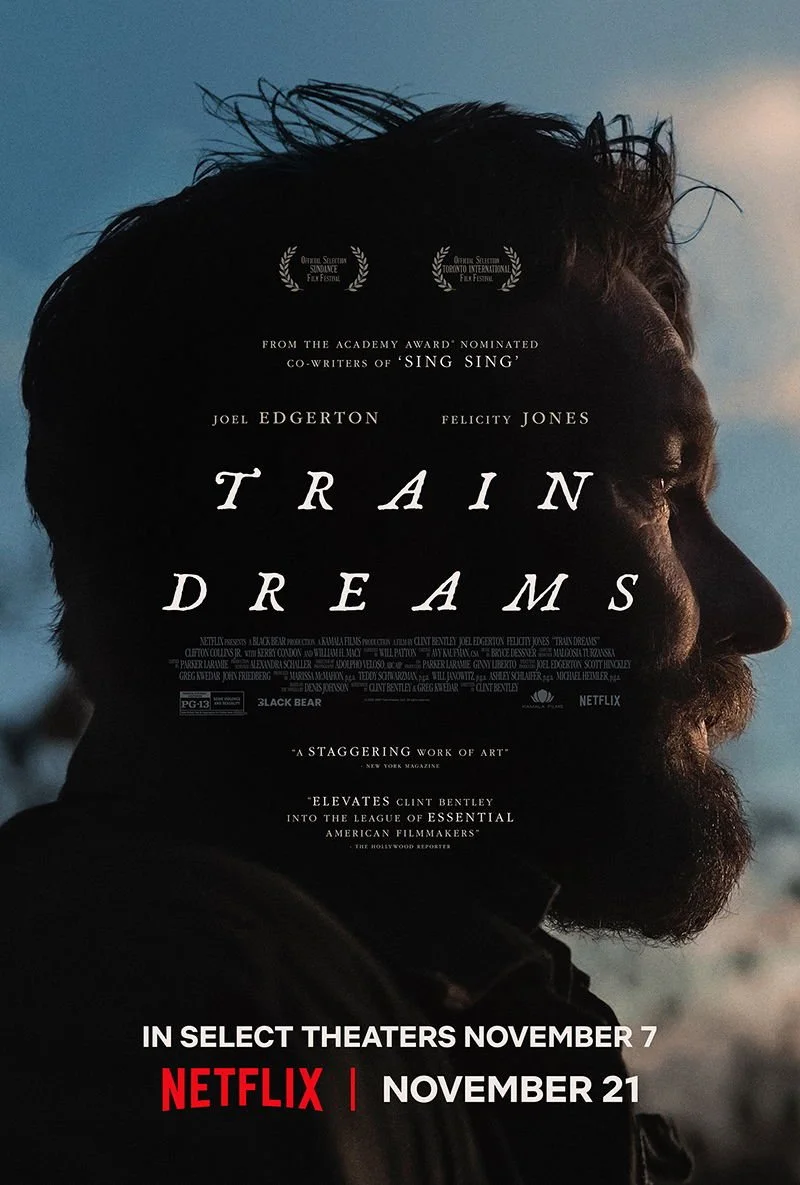
Train Dreams (2025)
dir. Clint Bentley
Rated: PG-13
image: ©2025 Netflix
One of the most beautiful observations about the human experience that I’ve ever encountered came from a film critic talking about the movie After Yang. I can’t quote it verbatim, but the central point was that every person has an entire universe dwelling inside of them. We’re all unknowable, in a way, because the sum of a person is every experience they’ve ever had.
In Train Dreams, director Clint Bentley, collaborating on the screenplay with longtime creative partner Greg Kwedar, has attempted to uncover the mystery and wonder of walking this earth for a couple handful of decades, creating the interior universe that makes up each and every one of us. Bentley and Kwedar have magnificently captured what a perplexing, sometimes exhilarating, often devastating journey a human life can be.
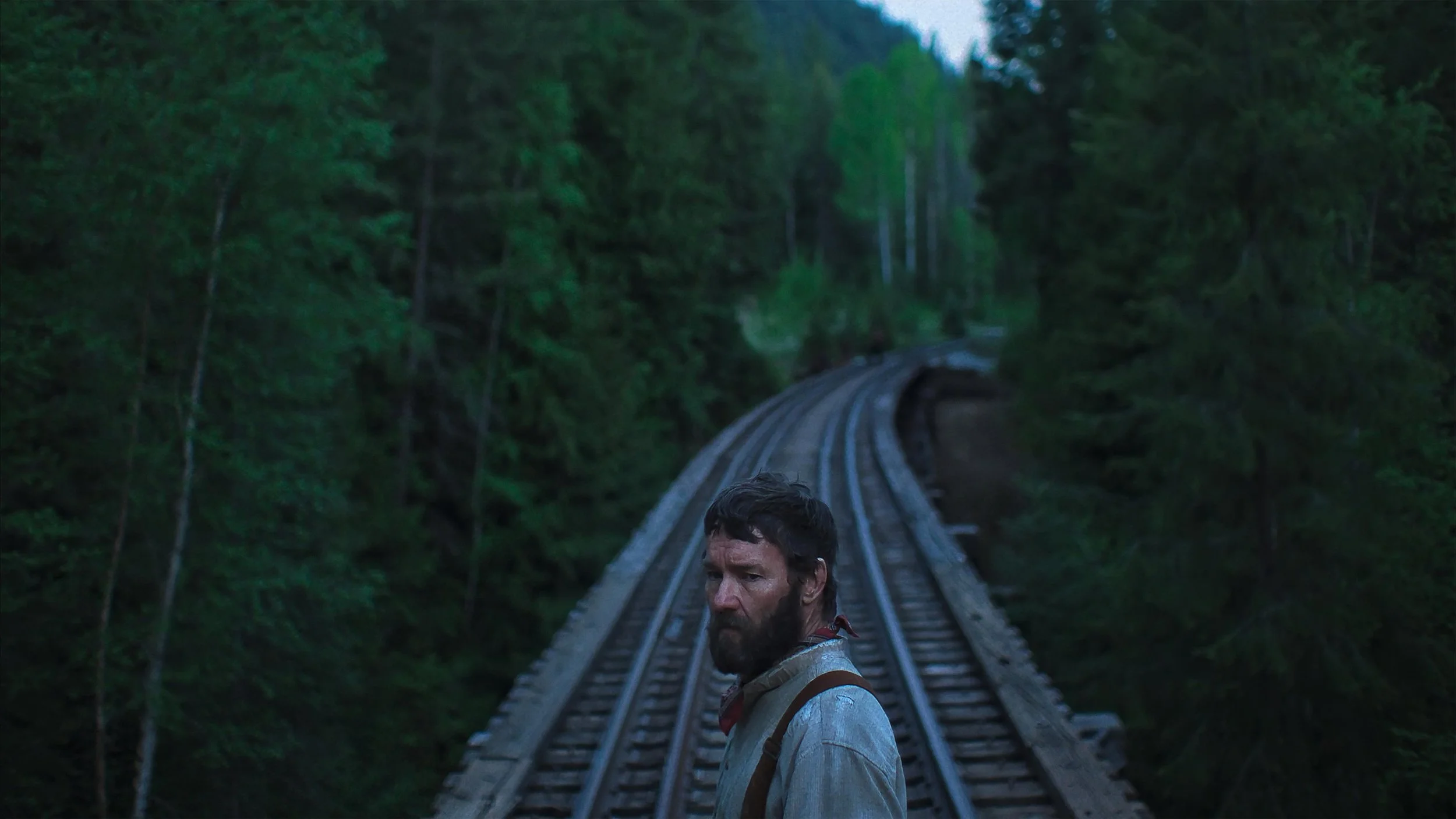
Based on author Denis Johnson’s award-winning 2011 novella, Train Dreams tells the life story of Robert Grainier. Orphaned as a child in northern Idaho at the tail end of the 19th century, Robert quits school in his mid-teens to work as a logger and in railroad construction, helping to build the crisscrossing network of rail lines that are transforming the country. Robert is directionless in life until, after a church service, he meets Gladys. The two become entwined in each other’s lives; they marry, build a cabin on an acre of land, and have a daughter, Kate.
The way that Gladys and Robert instantly fall into a rhythm of togetherness reminded me of my own marriage. When Robert asks Gladys to marry him, she befuddles him by telling him that they already are. “All we need now is a ceremony to prove it.” That’s how it felt for me and Rae. Since our first date, we’ve been a team, the (supposedly) necessary paperwork notwithstanding.
As the ruthless forces of capitalism dictate, Robert must spend most of his time away from the one place he most wants to be, at home with his family. We see episodes from Robert’s life, meeting the people with whom he toils and witnessing events he will never forget. Robert sees one of his fellow loggers gunned down by a man because he killed that man’s brother.
We meet Arn Peeples, an old codger whose knowledge of explosives allows him to duck out of any other work on the logging job site besides demolition. The other men laugh at Peeples’s failed attempts to ignite some TNT, until he gets the rig to work, then it’s awestruck applause all around.
After a terrible accident on the job involving a falling tree branch, Peeples becomes distant and confused. Reclining in the evening in the splendor of the forest with Robert after a hard day’s work, Peeples makes a simple yet devastating observation. “Beautiful, ain’t it?” “What is,” Robert asks. “All of it,” Peeples responds. “Every bit of it.”
It is until it isn’t.
Robert suffers a heartbreaking loss involving a forest fire. It throws his life into complete disarray and sets him back on the path of aimlessness that he was on before he met Gladys. Along the way, he gets too old for logging, mostly because the new technology – gas-powered chainsaws, for one thing – is beyond his grasp. The new men are younger and tougher. He gives up that life and purchases a team of horses and a wagon, making his living hauling people around the countryside for a fee.
That’s how he meets Claire Thompson, an employee for the United States Forest Service, who has come to the area to conduct surveys on the local forests. A recommendation from a family friend got Claire the job. She describes for Robert some of that recommendation, “Claire Thompson is absolutely devoid of the timidity normally associated with her sex.” Claire is building her own inner universe. She is also on this strange and wonderous journey called life, gathering up the experiences that will define her.
With its lyrical voiceover passages from an unseen and unknown narrator, Train Dreams evokes another meditation on western frontier life. The similarities between Bentley’s picture and Andrew Dominik’s breathtaking The Assassination of Jesse James by the Coward Robert Ford are impossible to ignore.
As mentioned above, both feature the same style of contemplative and melancholic voiceover, products of the literary roots of both films. Each movie includes unimaginably gorgeous natural landscapes captured with stunning cinematography – in the case of Train Dreams, from Brazilian director of photography Adolpho Veloso. The chiaroscuro effect that Veloso achieves in a few nighttime sequences lit by campfire are a wonder.
Both films even have an actor in common. Paul Schneider, who played James gang member Dick Liddil in Assassination, turns up in Train Dreams as Apostle Frank, a verbose logger hiding a secret.
But where the two films diverge is in their subjects. Whereas The Assassination of Jesse James is a rumination on fame, envy, and obsession during the American West’s march towards modernity, Train Dreams focuses on an everyman. Robert is unremarkable aside from his unique life experiences.
Instead of gaining infamy as a train and bank robber of the old west, as James did, Robert helps build what the trains run on. He finds work harder to come by after the Great War. He longs to spend time with his family, but is forced to spend most of the year away from home working for the railroad companies. He is as unfamiliar and mystified by a place called Chattanooga as he is by one called Shanghai.
Aussie actor Joel Edgerton – whose work I particularly enjoyed in 2017’s It Comes at Night and the 2024 Apple TV+ series Dark Matter, as well as Barry Jenkins’s phenomenal series The Underground Railroad – is quietly devastating as Robert Grainier. Edgerton plays the archetype of a man shaped by the culture and environment of the early 1900s with an ease and lived-in quality, making it look effortless. Felicity Jones, as Gladys, isn’t given much to do, but she makes every second of screen time count, whether it’s forming an emotional bond with her on-screen soulmate or waiting endlessly for him to return from his life on the road.
William H. Macy adds a profound gravitas to his performance as Arn Peeples, the old sage who pontificates on the wonder of the universe in which we all find ourselves. At one point, Peeples observes the delicate interaction of all things on earth, and how what these men do for a living – cutting down trees – might be negatively affecting the balance. He sounds like John Muir, the famous 19th century naturalist who, if he lived today, would be smeared as a tree-hugger by people who care more about exploiting nature than standing in awe of it.
Another movie that I low-key loved in 2025 that shares a similar guileless wonder to Train Dreams was The Life of Chuck. The words “hokey” and “cheesy” were thrown around to disparage that film, but maybe we need a little unabashed earnestness in our art right now to counteract the bottomless well of cynicism we find in the real world.
Both Train Dreams and The Life of Chuck reminded me to look up every once in a while, and acknowledge the splendor and mystery of existence itself. Every bit of it.

Why it got 4.5 stars:
- If you need a life-affirming movie that feels like a walk through the wilderness, Train Dreams is for you. It’s beautifully melancholic while also uplifting.
Things I forgot to mention in my review, because, well, I'm the Forgetful Film Critic:
- I loved the POV shot of a tree coming down near the beginning of the movie.
- Speaking of trees, in his brilliant 2011 history of cinema, The Story of Film: An Odyssey, filmmaker and critic Mark Cousins features several shots in movies of the camera pointed to the sky as the branches of huge trees sway in the wind. Cousins’s thesis statement in his hours-long documentary about the movies is that technology and homage have been the driving forces that have pushed the art form forward. He shows us how artists have referenced past films, and one of those examples are the shots of trees from a camera on the ground pointed straight up. We get one of those shots here in Train Dreams.
- Bryce Dessner’s plaintive, piano-heavy score — which also includes plenty of gorgeous string instrumentation — complements the film magnificently. It adds a wonderful elegiac quality to what’s on the screen.
Close encounters with people in movie theaters:
- I missed this Oscar Best Picture nominee in the theater. I caught up with it on Netflix, where it’s currently exclusively streaming.
————————————————————————————————————————————————————-
The FFC’s political soapbox
So, members of leadership in the US military are framing Donald Trump’s illegal, offensive war in Iran as the will of God, and that it will provoke the beginning of Armageddon. This is fucking insane. This is Christian Taliban shit. You can read all about it here. Three weeks until No Kings III. Trump must be impeached and removed from office.