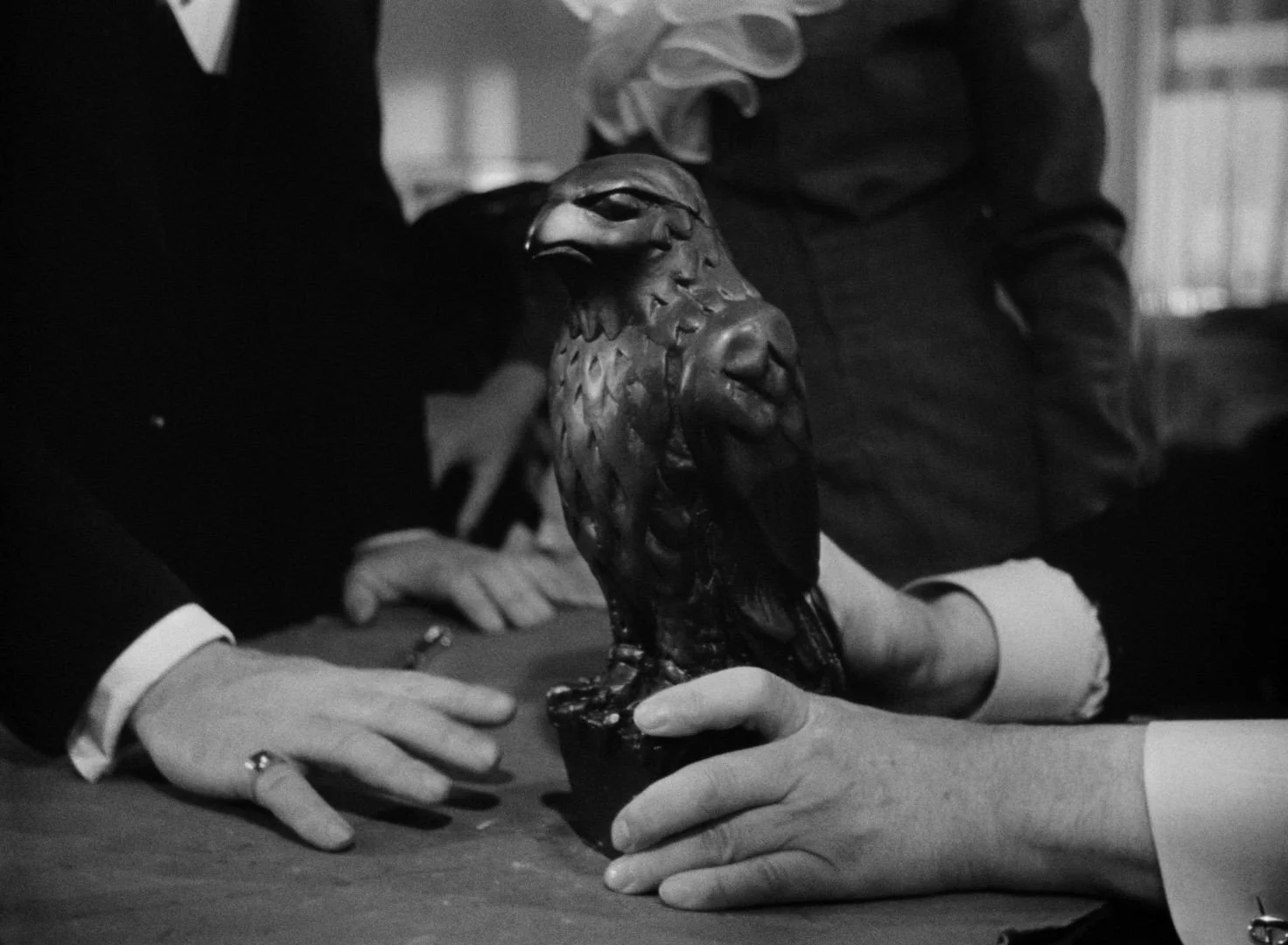
It’s been a hot minute since I’ve visited this special project. OK, it’s actually been, like, five years. Film number thirteen in my 100 Essential Films series (if you missed the first one, you can find the explanation for what I’m doing here) is The Maltese Falcon. It was produced at Warner Bros., which, by 1941, had started to gain a reputation for gritty crime stories. This was Hollywood’s third crack at turning Dashiell Hammett’s novel into a successful screen adaptation. The previous two efforts both failed at the box office.
I screened The Maltese Falcon on Blu-ray, borrowed from my local library. The transfer was pristine.
********************************
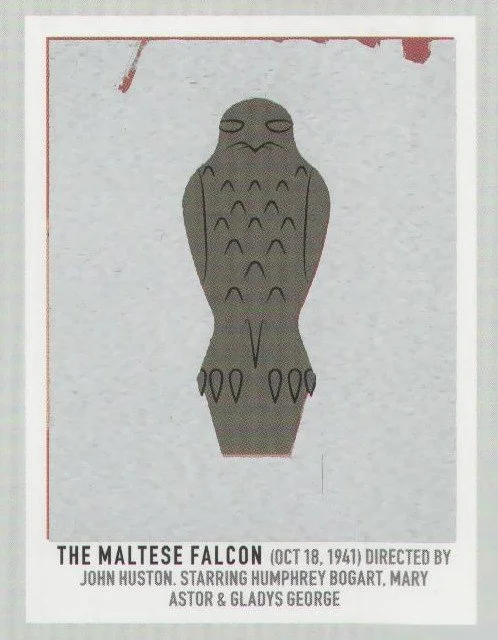
before scratch-off
The Maltese Falcon (1941)
dir. John Huston
Rated: N/A
image: Pop Chart Lab
The first – but not last – film noir included in this collection of 100 essential films is one of the earliest and greatest examples of the genre popularized in the wake of the death and destruction of World War II. In the realm of film noir, the heroes are cynical and always looking out for number one. The women are duplicitous and deadly, earning the moniker femme fatale. Life is cheap, and death is ever present, usually coming at the business end of a gun. The moral code is simple and brutal: get yours while the gettin’s good, because everyone else around you is trying to do the same.
Enter Humphrey Bogart as Sam Spade in The Maltese Falcon.
Although Bogie had already appeared in over forty films by the time he made The Maltese Falcon – and, prior to that, spent over a decade on Broadway – this tale of a jewel-encrusted, solid-gold statuette of a bird, and those desperate to find it, catapulted the actor to icon status. Bogart’s Sam Spade is pinch-mouthed and world weary. He laughs in the face of death, ready to meet his maker with a cynical quip. And there’s plenty of death to laugh in the face of throughout The Maltese Falcon.
After introductory text explaining that the Golden Falcon was to be a tribute paid to Charles V of Spain from the Knights Templar in the sixteenth century, only to be lost to pirates during its voyage, we meet Spade in his San Francisco private detective office. He’s one half of Spade and Archer – in an early example of shadow obscuring the light in films noir, the two private eyes’ names painted on their office window casts a bold shadow on the floor.
Spade meets with a woman calling herself Ruth Wonderly. She gives him a cock-and-bull story about a missing sister who fled from their home in New York with a man named Floyd Thursby. Wonderly says she knows where Thursby is staying, but that he has told her that her sister doesn’t want to see her. Archer agrees to tail Thursby, in an effort to find the missing sister. Wonderly’s story changes, however, after Spade gets a middle-of-the-night call that his partner has been shot dead. Later that morning, Thursby also turns up dead.
In this femme fatale’s first admission of duplicity, Wonderly admits that her real name is Brigid O'Shaughnessy. There is no sister, she tells Spade, and Thursby was actually her partner. She begs the private eye to help find the person who killed Thursby. The plot thickens further when a man named Joel Cairo shows up in Spade’s office – Sam has already instructed his secretary, Effie Perine, to have the door and window repainted with “Samuel Spade”; in the world of noir, grief is as useless as sentimentality – offering $5,000 to find a "black figure of a bird."
When confronted with the appearance of Cairo, O'Shaughnessy admits that she knows the man, and, during a meeting of the three arranged by Spade, she acknowledges that the source of her actions up to this point is due to the “Fat Man,” Kasper Gutman, arriving in San Francisco. Gutman, like Cairo, O’Shaughnessy, and the recently departed Thursby, are all trying to get their hands on the Falcon, what Spade hilariously starts to call in the latter half of the movie, “the dingus.”
Based on Dashiell Hammett’s 1930 novel, director and screenwriter John Huston’s feature film debut is meticulously plotted, a product of Huston’s extensive preparation during pre-production. The aspiring director included notes to himself in his screenplay for each and every shot of the film, as a way to ensure that shooting went as smoothly as possible.
Huston, the son of popular actor Walter Huston – who makes an uncredited appearance in The Maltese Falcon – had already built a successful and respected career as a writer, both in Hollywood and elsewhere, before making the decision to try his hand at directing motion pictures. After penning the box office success High Sierra – which made Humphrey Bogart a star in his first major Hollywood role – for Warner Brothers, the studio kept their promise to let Houston direct.
One of the things that most excited me about Houston’s direction is his use of fluid camera movements during key moments of the film. This was 1941, following roughly a decade of Hollywood making the transition from silent pictures to “talkies.” That period, most of the 1930s, is infamous for “motion pictures” becoming frustratingly static, as techniques were tested and refined to better marry sound and image.
This stunning new technology led to the movies, well, moving less, as the artists and technicians incorporated it. One shot within O'Shaughnessy’s hotel suite exemplifies Huston’s dedication to creating dynamic camera movements. As a vital piece of information is revealed, the camera sweeps around and forward to capture a closeup of O'Shaughnessy’s distressed face.
The superb cast of The Maltese Falcon feels like a dry-run for a movie that would follow the very next year. Casablanca, in which Bogart expanded upon his hard boiled, pitiless persona as Rick Blaine, also includes the delightful Sydney Greenstreet. First portraying “Fat Man” Kasper Gutman in Falcon, Greenstreet plays a variation on Gutman in Casablanca. The great Peter Lorre, who plays the nefarious Joel Cairo in Falcon, embodies the similarly morally ambiguous Signor Ugarte in Casablanca.
On the topic of morally ambiguous, The Maltese Falcon provides one of the most infamous examples of villains in Hays Code Hollywood being coded as queer. Lorre’s Joel Cairo, a man who will do anything and hurt anyone in search of the dingus, wields a cane so phallically in one scene that it would have made Sigmund Freud proud.
He strokes the cane and caresses the edge of his mouth with it during the scene. It should be noted that the character is explicitly gay in Hammett’s source novel, but that attribute had to be soft-peddled in the movie due to the self-censoring dictates of the Hays Code. The character is examined in the fantastic 1996 documentary about homosexuality in Hollywood, The Celluloid Closet.
In his very first screen role, Sydney Greenstreet portrays Gutman as a man ready for any adventure in pursuit of his white whale – the Falcon. Gutman is up for any form of treachery to obtain his goal, but Greenstreet hides this attribute of the character under a disarming laugh (at times, it’s a giggle), and his never-ending astonishment at the cleverness and resourcefulness of Bogart’s Sam Spade. I lost count of the number of times Gutman tells Spade during the movie something to the effect of, “You really ARE a most interesting man, sir,” with that inimitable Sydney Greenstreet delivery.
Mary Astor does her best as the duplicitous Ruth Wonderly/Brigid O'Shaughnessy, but the actor comes across as a bit too clean-cut to be believable as a femme fatale, despite embodying one of the earliest examples of the noir trope. She lacks the sharp edge and acerbic demeanor of someone like Barbara Stanwyck as Phyllis Dietrichson in Double Indemnity or, in an example of neo-noir, Faye Dunaway as Evelyn Mulwray in Chinatown.
I also wasn’t buying the rather feeble manufactured romance between Spade and O’Shaughnessy in The Maltese Falcon. The two characters falling in love reeks of the requirement that there be a love story present in all crowd-pleasing Hollywood fare. It feels shoehorned in, and happens entirely too quickly to be anything resembling believable.
Those few faults of the movie are easy to overlook, however, when we get gems like Humphrey Bogart slinging dialog about, “you birds cracking foxy.” There’s also an undercurrent of the folly of seeking material wealth – in the form of the Falcon – running throughout the film. Dashiell Hammett was, after all, a lefty who, in 1937, joined the Communist Party.
With the assistance of Hammett’s source material, The Maltese Falcon helped shape a key genre in film history, and the dingus, like the Hollywood factory that produced it, is, as Spade tells us in the movie’s closing moments, “the stuff that dreams are made of.”

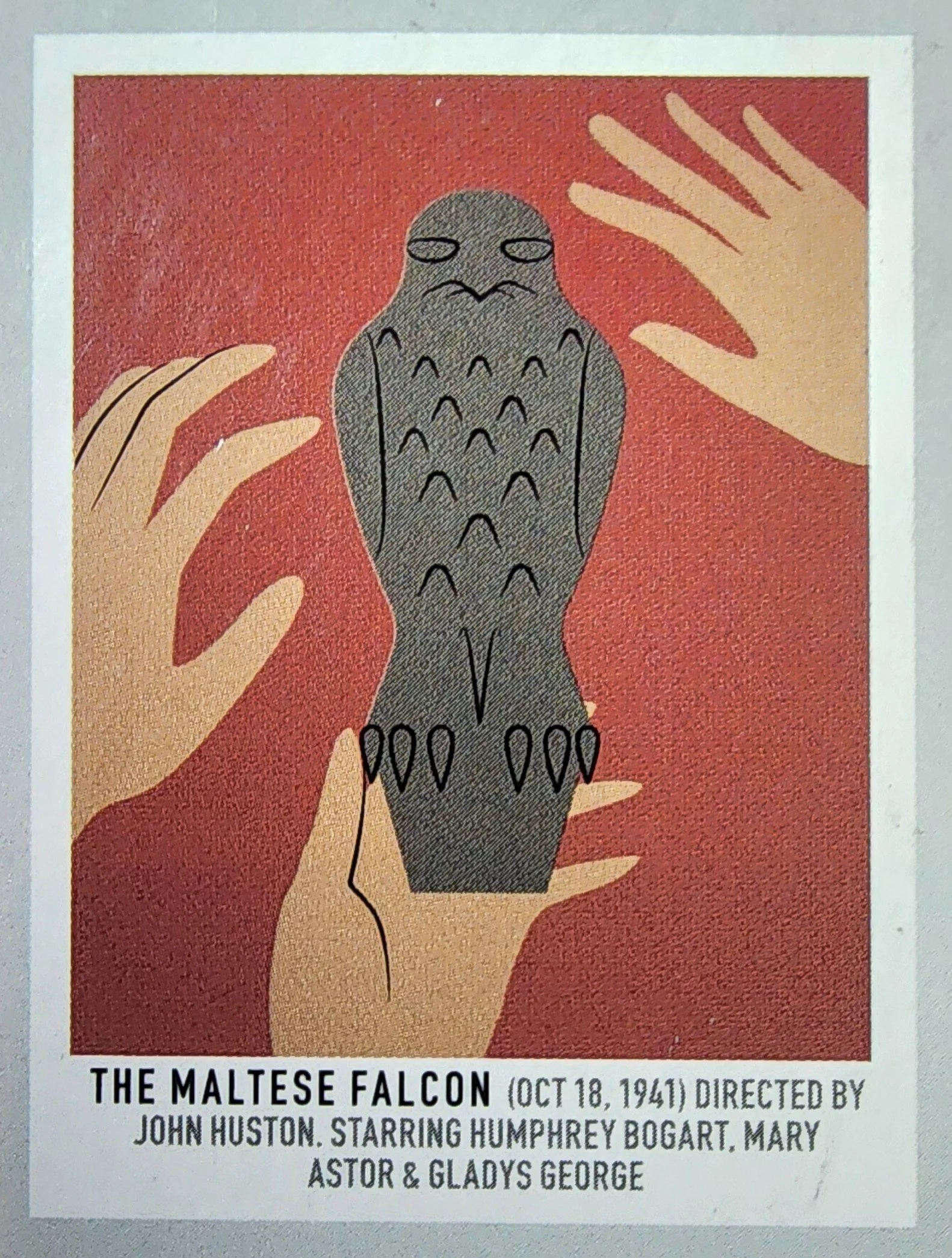
after scratch-off
image: Pop Chart Lab
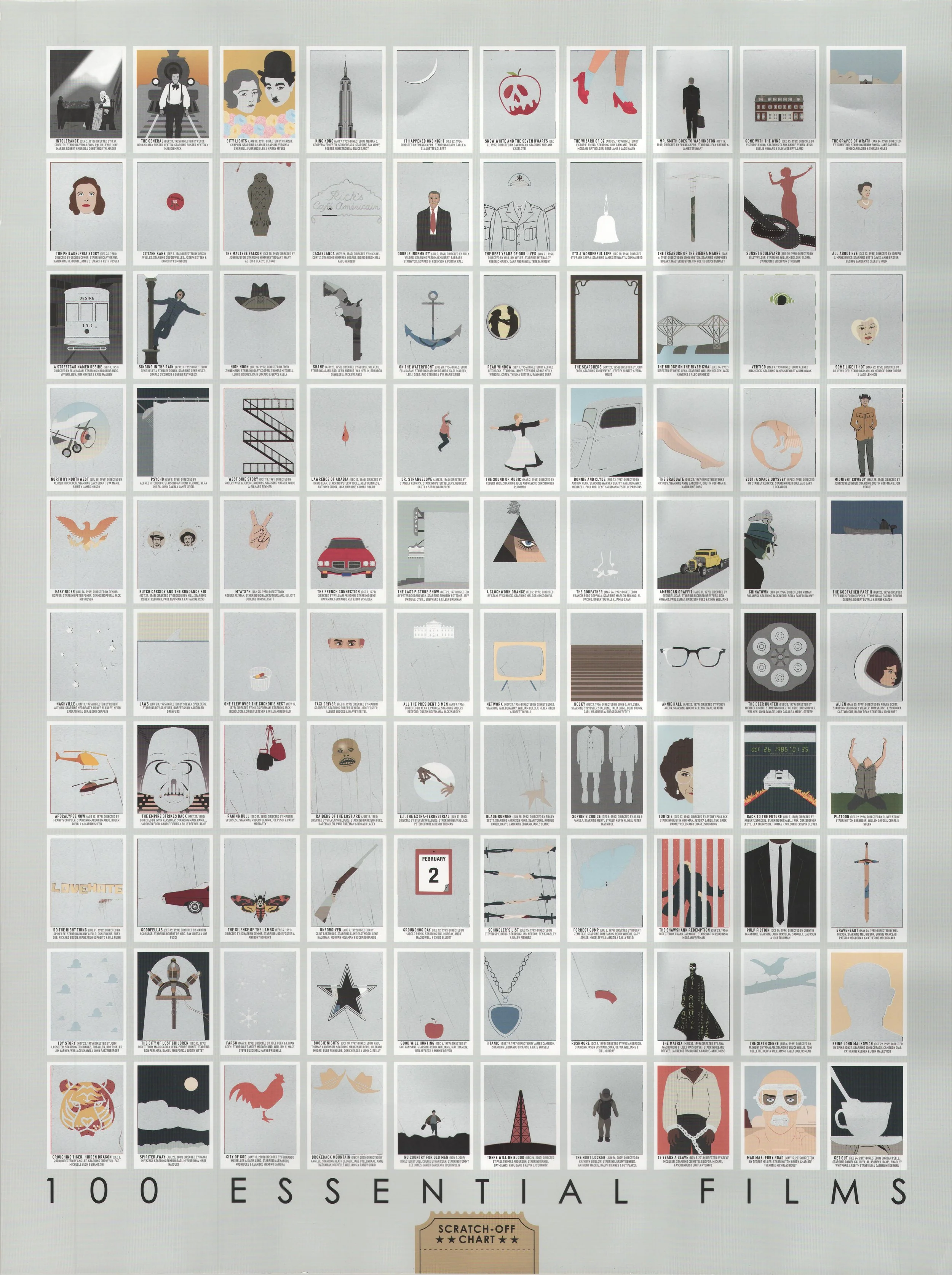
image: Pop Chart Lab