I Saw the TV Glow (2024)
dir. Jane Schoenbrun
Rated: PG-13
image: ©2024 A24
There are two movies living inside of I Saw the TV Glow. That’s an apropos description based on the more salient and deeply felt story that director Jane Schoenbrun wanted to tell. In that movie, the characters and, indeed, the entire aesthetic of Schoenbrun’s richly created world of high school angst, adolescent uncertainty, and familial trauma is a metaphor for coming to terms (or not) with trans identity. The second movie, which lives on top of that exploration of gender and body dysmorphia, is a mediation on obsession with pop culture artifacts and the blurring of reality and fantasy that can come with that obsession.
Initially set in 1996, I Saw the TV Glow introduces us to Owen, a shy and reclusive kid who doesn’t quite fit in with his peers. One night at a special school function called “election night,” Owen meets Maddy, a high school freshman who tells Owen – when he says that he’s in the seventh grade – “you’re practically a baby.” Maddy also remarks on the magic of election night. “The school gets transformed into something else,” on that night, she intones.
Maddy is a fanatic, in the truest sense of the word, of a young-adult TV show called The Pink Opaque. She’s studiously and intently reading an episode guide for the show when she and Owen meet. Owen knows what The Pink Opaque is, but it airs past his bedtime – 10:30 to 11PM on Saturday nights – so he’s never seen it.
The show revolves around two teen girls, Isabel and Tara, who meet at a sleepaway camp in the pilot episode, and who remain in contact via a connection in “the psychic plane.” The main villain of the show, whom Maddy refers to as the “big bad,” is a diabolical creature named Mr. Melancholy, who can warp time and reality. The two girls use their connection in the psychic plane to battle the supervillain. In each episode, Mr. Melancholy sends a new monstrous minion to defeat Isabel and Tara. These “monster of the week” episodes give way to occasional mythology episodes that further the show’s overarching plot.
In order to watch the show with her, Maddy convinces Owen to stage a sleepover with another friend. When his mom drops Owen off for what she thinks is a routine night with his friend, he flees the house without ever ringing the doorbell and heads straight for Maddy’s house. She and another of her friends practically ignore Owen as they drink in every last detail of that night’s episode while watching it in the basement.
After the show, Owen needs a place to sleep, since his mom thinks he’s spending the night elsewhere. Maddy tells her new acquaintance that he can sleep on the floor of the basement. He can’t make a sound, though, because if her dad discovers the stowaway, he’ll “break my nose again,” she tells Owen. The two form a bond as Maddy leaves VHS tapes with episodes of The Pink Opaque on them for Owen to collect and watch.
Two years later, Maddy, who sobs uncontrollably while watching the show with Owen during another illicit sleepover, tells her friend that she’s decided to run away. She can’t stand her living situation any longer, noting that The Pink Opaque feels more real to her than her actual reality. Maddy is a lesbian, and the suburbs of her everyday reality is too stifling for her to stay.
Owen initially agrees to go with her – his own home situation is precarious; his mother is battling cancer and his father is distant and obliquely threatening – but he loses his nerve, and Maddy disappears. In 2006, Maddy suddenly reappears and tells Owen that The Pink Opaque is real and that she has lived there for the past eight years.
The two have this crucial conversation in a bar where Maddy feels like it’s “safe” for she and Owen to speak frankly. The bar is coded as an LGBTQ+ friendly space. The sequence features two musical performances from queer-coded singers. This is where I have to admit that I’m a cishet guy originally from rural East Texas, so I have absolutely no experience when it comes to these kinds of conversations or the need to find a safe space in which to have them.
Schoenbrun masterfully uses The Pink Opaque as a metaphor for discovering queer and trans identities – secret and special realities within white, straight, patriarchal society. The director has spoken in interviews about how they were similarly obsessed with Buffy the Vampire Slayer when growing up, a TV show popular with the LGBTQ+ community for its queer camp aesthetic and themes.
The body horror of I Saw the TV Glow dovetails heartbreakingly with the lived experience of gender and body dysmorphia. Taking into consideration my admission above, the only reason I can make anything like the previous statement is because Schoenbrun, though their movie, successfully uses a fantastical story to make someone like me understand what those concepts must feel like.
More importantly, their movie functions as a way for trans people to feel wholly seen. The double function of their movie – in which the director uses pop culture signifiers as a way for cishet folks to latch on to the story – is a perfect example of what Saint Roger described as the highest achievement of movies as an empathy machine for humans to understand one another.
The Pink Opaque also works as a metaphor for the world that lies just beyond the grasp of people like Owen, who know that they are different, but who aren’t convinced – with good reason – that our current society will welcome their true selves. During the opening act of I Saw the TV Glow, in which we see Owen become obsessed with the show, his father dismissively observes of The Pink Opaque, “Isn’t that a show for girls?” It’s telling that this one line, wherein Owen’s father equates any cultural artifact that’s female-centered as being lesser, is the only time in the entire picture in which the character speaks.
In one of the most fantastical bits of the movie, in which Owen tries, and almost succeeds, to enter the world of The Pink Opaque through his television, Owen’s father violently pulls him back out of it. It’s akin to a queer or trans kid stepping into a more realized version of themselves through dress or behavior to only then have a parent vehemently put a stop to it.
I don’t want to spoil too much, but by the end of the film, we see the unimaginably tragic toll that denying one’s true identity can take on a person. I Saw the TV Glow is a tale of hope, as one of the most powerful lines in the movie reminds us, plastered in fluorescent chalk written on a suburban street – “there is still time.” But it’s also a cautionary tale about the cost that society exacts on trans people by trying to make them conform to a version of themselves that feels totally alien to them.
The conceit of having Owen narrate his story to us in voiceover, like he’s inside a TV show or movie himself, is a nod to the fact that his living in The Pink Opaque – and, by extension, acknowledging who he really is – feels more like reality to him than the real world around him.
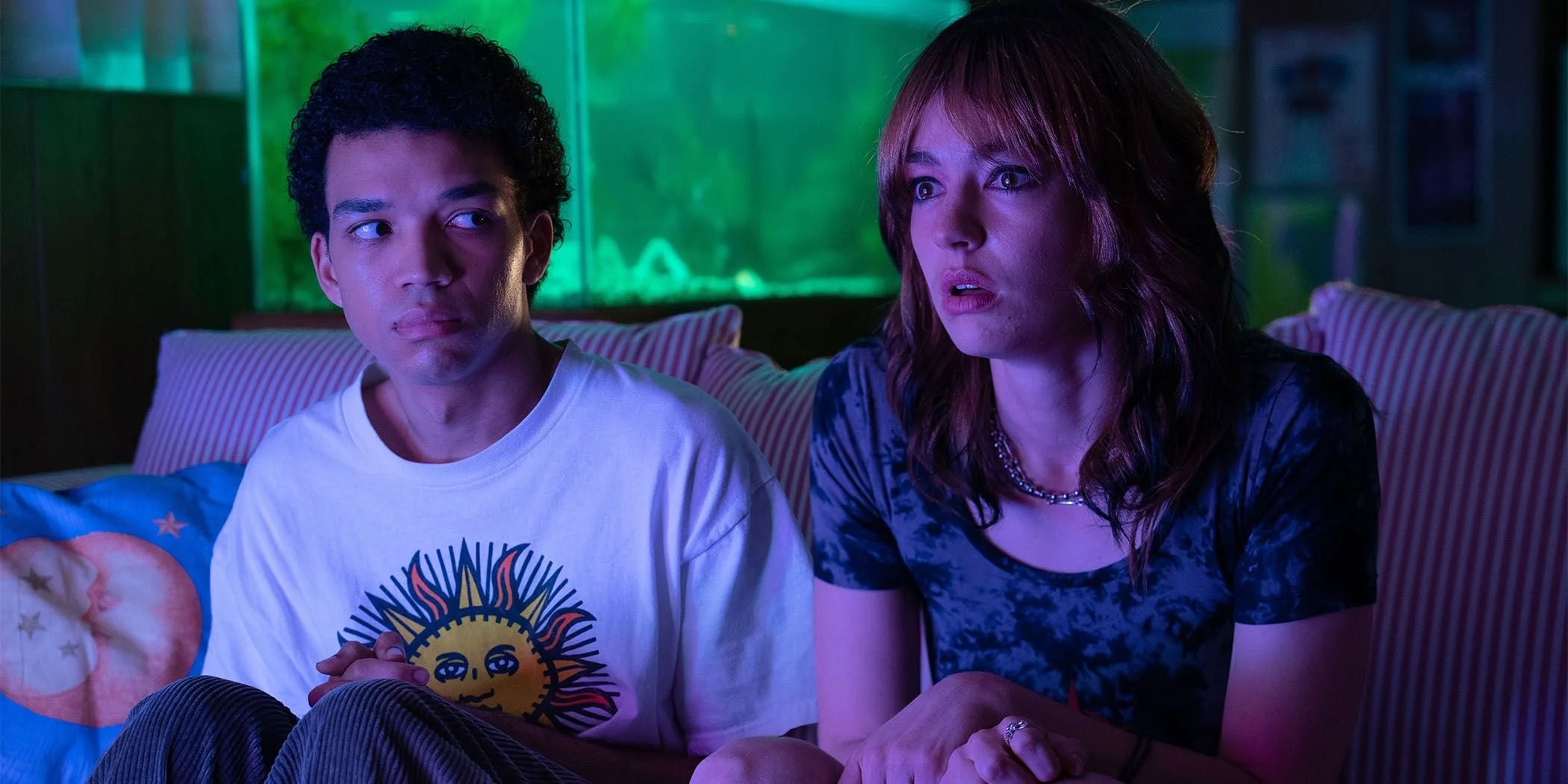
Aside from the heavy themes and emotionally fraught examination of LGBTQ+ experiences that Schoenbrun is tackling, their movie is also a visually stunning effort from start to finish. The fluorescent color scheme of the movie, especially when it’s being thrown from a TV screen onto the main characters’ faces, is transfixing.
Schoenbrun and their creative team’s expertise at creating arresting visuals, which are also on display in their disorienting feature debut, 2021’s We're All Going to the World's Fair, are disturbing and mesmerizing in equal measure. The world of The Pink Opaque, especially the climactic sequence featuring a hellish turn by Mr. Melancholy, is expertly crafted and gives I Saw the TV Glow an added weight that it wouldn’t otherwise have.
The performances from the two leads are tenderly rendered to relate what moving through the world in a body that doesn’t feel like the right one, or with a sexuality that isn’t accepted by straight society, must be like. Jack Haven, who plays Maddy, is gruff and guarded, even with people she considers friends, like Owen. (I’ll note here that Haven came out as non-binary in 2019, and they changed their name in 2025 to Jack Haven from a more typically feminine name with which they were credited for I Saw the TV Glow, a 2024 release.)
Justice Smith delivers a hauntingly tortured performance as Owen. The character is like a mouse, scurrying at the edge of his own life in order not to be noticed. The repeated and numerous apologies from Owen in the devasting final seconds of I Saw the TV Glow haunt one long after the movie has ended.
Schoenbrun and I Saw the TV Glow deal with heavy topics, but I want to take a moment to lighten things up a bit. The filmmaker uses a preoccupation with pop culture as a way into their movie for audiences who might not ever think of the issues explored above. As stated earlier, in interviews, Schoenbrun has mentioned their obsession with Buffy the Vampire Slayer. The Pink Opaque is also riffing on a phenomenon popular in my own childhood, Nickelodeon’s Are You Afraid of the Dark?, a kids horror anthology series originally airing in the early to mid-1990s. (I’ll also note that Schoenbrun and myself are separated in age by only seven years.)
The director has also referenced The Adventures of Pete & Pete (another favorite of mine growing up), a Nickelodeon show in which weird things happen in the world of the child protagonists, but go completely unnoticed by the adults in the series. Schoenbrun has spoken about looking forward to these shows and others growing up as a way to escape everyday life.
Our reasons might be completely different, but the way that Maddy, and later Owen, are completely consumed by The Pink Opaque is identical to the way I felt about The X-Files growing up. That was the show that made me feel like a grown-up; it was like I was uncovering truths and revelations that only those of us completely devoted to the show would understand. I chuckled to myself as Maddy tells Owen early in the movie that the mythology of The Pink Opaque is “way too complicated” for normies to understand. That might as well have been me speaking at age fifteen about The X-Files.
Schoenbrun’s film is a moving and heartbreaking examination of the hell that certain people must go through because their authentic selves aren’t welcome in society-at-large. They use the signifiers of pop culture as a way to liberate and validate people who don’t conform to straight society’s very narrow perception of acceptable ways to exist in the world. I Saw the TV Glow tackles these issues with a stunning visual style and hypnotic storytelling prowess.
Why it got 4.5 stars:
- With a transfixing visual style and layers of meaning, I Saw the TV Glow is a heartbreaking look at the cost of denying who you are.
Things I forgot to mention in my review, because, well, I'm the Forgetful Film Critic:
- I decided to wrestle with I Saw the TV Glow in the form of a proper review for two reasons. First, I never did so during it’s initial theatrical release in 2024. Second, I was able to see it again last week as part of CinéWilde, a monthly film series focusing on movies with LGBTQ+ themes held at the Texas Theatre. In the past, I’ve attended CinéWilde screenings of Paris Is Burning and The Celluloid Closet. Both movies are phenomenal, and you should check them out.
- Bonus points to Schoenbrun for naming the high school Void, meaning that its initials are VHS, as well as the vintage Fruitopia vending machine included in one scene. I would love to know where they found it. Man, I used to love me some Fruitopia in high school.
- In case anyone out there is wondering, yes I did own several X-Files episode guides. I believe I had the volumes covering the first five seasons.
- The look of the world within The Pink Opaque is magnificent. Ditto the cheesy effects, stories, and acting that Owen discovers upon revisiting the series years later on streaming.
- We see Owen working in a movie theater in the mid-2000s, and the absolutely terrible mid-2000s CGI effects we see on the screen as Owen walks through an auditorium are hilariously accurate.
- There are two moments in the film that are very noisy and are then followed by complete silence as a punctuation mark on what comes right before it. These moments were incredibly effective in a theater full of people.
Close encounters with people in movie theaters:
- I Saw the TV Glow was screened in the upstairs theater at the Texas, and it was a full house. As you might imagine, the crowd was super into it, which lead to an electric feel in the air as we watched it. It’s currently available for rent or sale on most streaming platforms.
————————————————————————————————————————————————————-
The FFC’s political soapbox
Your countdown starts now. No Kings III protests are scheduled for Saturday, March 28 in order for people all across the country to peaceably gather and demonstrate our revulsion towards the tin-pot dictatorship that the Trump regime is trying to replace our constitution with. Find out where you can join the fight here.