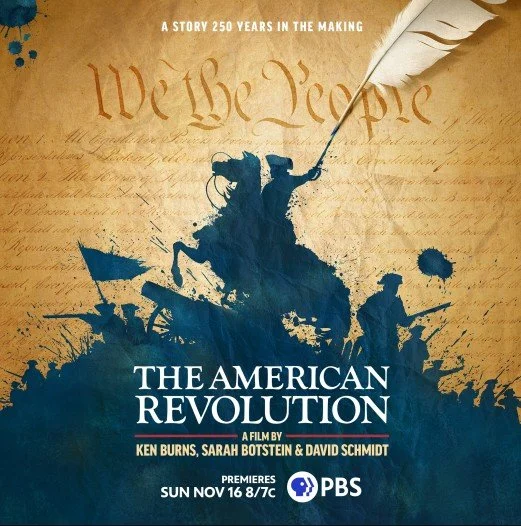
The American Revolution (2025)
dir. Ken Burns, Sarah Botstein, David Schmidt
Rated: TV-14
image: ©2025 Florentine Films
As I write these words, there is a little over a week left before early voting begins here in Texas for the November third midterm elections. If you’re reading this immediately upon my publishing it, early voting starts on Monday, October nineteenth. The review you’re about to read, for Ken Burns’s latest historical deep dive, this time on the American Revolution, was started way back in January.
Anybody who’s been paying attention knows that my output over the course of 2026 has been the lowest since I created this website at the tail end of 2014. Besides the film festivals I’ve covered this year, I have struggled to publish much of anything at all. Even my coverage of festivals for the year has been appearing weeks, or, in the case of my recently published coverage of the Oak Cliff Film Festival, months after the fests ended.
The reason, if you know me at all, is probably pretty easy to guess. I’ve been in a state of acute depression as I’ve watched my country, and, to different extents, the world, continue to fall apart because of the corruption and the sadistic, disgusting behavior of the fascist Trump regime and their supporters.
I’ve watched armed government thugs – Immigration and Customs Enforcement, or ICE, is Donald Trump’s version of Hitler’s secret police, the Gestapo – shoot American citizens, as well as people who came to this country to find a better life, openly in the streets. I’ve watched as my country’s military began an illegal, immoral war of choice against the nation of Iran. (A nation that fell into theocracy and authoritarianism, I’ll note, because of the direct actions of the United States government in the 1950s.)
I’ve hit a new low since Pete Hegseth, the buffoonish Secretary of Defense (I refuse to call it the Department of War) who mistakes cruel might-makes-right aggression for strength and honor, announced that the nation I call home will host a public execution. If the livestream of the murder of Nidal Hasan, the Ft. Hood shooter, by firing squad takes place*, the United States will join North Korea, Saudi Arabia, and, ironically, Iran, as countries that make a public show of state sanctioned violence and murder.
What the fuck is happening to us?
A YouTube streamer that I watch regularly made the point in a recent stream that what he was taught growing up – he was born in 1988, eight years after me, so we likely had very similar formative years – was to treat everyone with kindness and respect. His kindergarten and elementary school teachers taught him, like me, that every person, no matter their race, religion, or creed, should be treated equally. We were most likely both raised with the help of Mr. Rogers.
This is, of course, why the Trump regime and the Epstein class are doing everything in their power to destroy the public education system for regular people. When only the rich and powerful in a society are educated, that makes controlling everyone below them that much easier.
We must stand up to this fascism, hate, and corruption. None of it is normal. None of this is normal. The only reason any of this is happening is because we are allowing it to happen. Please vote in the upcoming election. Please vote for only Democrats. They are certainly not perfect – the ruling members of the party remind me more and more of Neville Chamberlain every day – but they are the last rampart between our free society and a Christian Taliban theocracy akin to Gilead in The Handmaid’s Tale.
In addition to voting, you can show up in the streets with other like-minded people at the fourth No Kings Day protest, happening on Saturday, October seventeenth. You never know what could come out of a relationship sparked because of No Kings.
I’m hoping that the below review of Burns’s The American Revolution will serve as inspiration for what the best version of ourselves might look like, and as a call to arms to fight against those in power who want everyday Americans to bow our heads in submission to their sadism and unquenchable greed.
**********
Over the course of The American Revolution’s six episodes and whopping 715-minute length, it’s what directors Ken Burns, Sarah Botstein, and David Schmidt never explicitly say about the birth of this nation, which I call home, that’s most important. The newest sprawling project – which premiered on PBS in November of 2025 – from legendary documentary filmmaker Burns and his Florentine Films, features over twenty-five interviewees, nearly sixty voice-over performers, 150+ shooting locations, and the commission of 100 new maps recreating the topography and political realities of 18th-century North America.
Knowing all that, you might be wondering to yourself how it’s possible that Burns and his team left much of anything unsaid on the topic.
The key here, as is the case with most great art, is in the artist’s ability to present ideas to the audience with the confidence that they will make connections to the larger, unspoken themes of the work. One thing becomes starkly clear If you’re paying attention to what Burns, Botstein, and Schmidt – with the incalculable help of writer Geoffrey C. Ward, who holds the sole screenwriting credit for all of The American Revolution – are saying about the British colonialists who defied their king for a chance at self-determination.
In direct opposition to what the current Trump regime’s clown car of white nationalist, xenophobic, and racist members spew about how the United States of America was formed and, more importantly, who it’s for, The American Revolution makes unequivocal the fact that, from the very beginning, we were a pluralistic people.
As The American Revolution makes clear, the people who fought to forge this new nation were most assuredly not all white. Both free and enslaved Black people, as well as members of every Indigenous tribe that interacted with the British colonies, formed an alliance with the wealthy white colonialists to sever their ties with the tyrannical British monarchy.
The reasoning, motives, and goals for this motley coalition were myriad. The documentary also doesn’t shy away from the fact that the wealthy white planters, farmers, and businessmen leading the revolutionary movement consistently and continuously fucked over their compatriots. From the ongoing theft of Indigenous lands to the enshrining in the nation’s founding documents of the odious, vile, and sickening institution of slavery, Ward’s writing strives to address the uncomfortable nuances of the people involved in the struggle for freedom.
Nothing of the above is to suggest that The American Revolution is some radical leftist interpretation of the founding of the United States. (No matter how much someone like the grotesque Stephen Miller might try to convince you otherwise.) For that, you’ll need to seek out one of the most incendiary and necessary critiques of US history and policy every produced, historian Howard Zinn’s seminal 1980 book – updated in 2003 – A People’s History of the United States. (See also Roxanne Dunbar-Ortiz’s more specific 2014 continuation on Zinn’s foundation, An Indigenous Peoples' History of the United States.)
Still, you can see certain arguments from Zinn’s work, like the acknowledgement that much of the revolutionary spirit of late-1700s North America was rooted in how much money there was to be made in throwing off British rule, swirling in The American Revolution’s examination.
As with Burns’s iconic 11.5 hour, nine-episode 1990 documentary The Civil War – also written by long-time collaborator Geoffrey C. Ward, with the help of Burns’s brother, Ric Burns – the bulk of The American Revolution details the military campaigns, strategy, and battles of the war. My biggest critique of the project is that Burns et al. focus so intently on the fighting that it occasionally feels like the political jockeying from the likes of Jefferson, Franklin, or Hamilton are pushed to the side. In between passages of Washington’s army’s winter deprivations or General Cornwallis’s tactics during battle, we are reminded of the Continental Congress’s efforts to supply the troops with materiel, almost as an afterthought.
The documentary sets the stage for the colonists’ rebellion by opening in 1754 at the outset of the French and Indian War, in which the global powers of Britain and France fought over trade routes and economic supremacy in what is now southeastern Canada and the northeastern United States.
Burns and Ward put this war into the broader context of a worldwide conflagration between these two vast empires and their struggle to extract wealth from far off lands in pursuit of global dominance. (As I say constantly in my day-to-day personal conversations, the only thing that we human apes really care about – despite our endless declarations to the contrary – is money. So, it shouldn’t be surprising that this wider global conflict, like the American Revolution and most other wars, was driven primarily by economic concerns.)
Britain might have been the perceived victor of the French and Indian War, but it was something of a Pyrrhic victory. The war proved to many of the American colonists what they suspected. Their faraway British overlords saw the inhabitants of the colonies as grist for the imperial mill, nothing more than resources to be exploited for the continued wealth and glory of Brittania.
This realization, coupled with growing anger over King George’s attempts to subjugate his not-so-loyal and royal subjects via a series of onerous taxes, sparked rebellious sentiment. If there’s one thing that every United States citizen can tell you about our origin story, it’s the phrase, “no taxation without representation,” although, as The American Revolution takes pains to make clear, that’s a grossly simplified sloganization of the actual events.
Burns’s prestige as one of the foremost chroniclers of American history via the means of documentary film drew dozens of A-list actors to the project. Their voiceover contributions, in which they voice some of the most iconic figures involved in the nation’s founding, give the audience an anchor to identify who we’re hearing at any given moment. Josh Brolin provides the quiet authority of George Washington. Claire Danes brings the voice of Abigail Adams to life.
Meanwhile, Jeff Daniels intones the words of Thomas Jefferson, the man who, as The American Revolution illustrates, founded a nation on the ideals of liberty and freedom while also owning other human beings in the bonds of chattel slavery. I particularly enjoyed the casting of Paul Giamatti as John Adams. Burns gave Giamatti the chance to effectively reprise his iconic performance of the founder in the 2008 HBO miniseries John Adams.
And overseeing the entire film is Peter Coyote as the film’s narrator. The actor’s haunting, gravelly voice is near-omnipresent throughout The American Revolution. I’ve been a fan of Coyote for decades, and I enjoyed the year he MCed the Oscars ceremony. The man was born for voiceover work; he probably sounded like he had just taken five shots of whiskey upon his appearance in the delivery room.
I’m absolutely loath to quote Ronald Reagan, a man I find particularly despicable for the views he held and the way he harmed people with his policy throughout his presidency. But I also have to give credit where credit is due. During remarks at the groundbreaking ceremony for the Ronald Reagan Presidential Library, Reagan opined:
“I would add just one thing that recently came to me in a letter. A man wrote and found it necessary to say this, and I'm pleased that he did. He said, you can go to live in another land -- you can go to live in France, but you can't become a Frenchman. You can go to live in Germany, but you can't become a German. You can go to live in Japan or Turkey, and you cannot become Japanese or Turkish. But anyone, from any corner of the world, can come to live in the United States and become an American.”
That is essentially, for me, what the entire idea of the United States of America is. I’ll quote another U.S. president: “A lot of shelter dogs are mutts like me.” That was Barack Obama, on the occasion of the First Family adopting Bo, a shelter dog, to live with them in the White House. Obama is biracial. I don’t remember now, but I’m sure the odious rightwing media raked him over the coals for his attempt at self-deprecating humor.
But here’s the thing. We are a nation of mutts. We’re a nation of religious zealots and castoffs from Europe. My dad once told me that his familial forebears came to America because they were kicked out of England for horse thieving.
"Give me your tired, your poor,
Your huddled masses yearning to breathe free,
The wretched refuse of your teeming shore.
Send these, the homeless, tempest-tost to me,
I lift my lamp beside the golden door!"
The Trump regime and those inside it are trying to convince us that none of this is true. They want a white, Christian homeland sanitized of people of color, the queer community, atheists (that’s me!), Muslims, and anyone else who makes them feel uncomfortable. The American Revolution stands diametrically opposed to this fascist worldview.
We have never been a homogenous society. There have been Black, indigenous, and queer people among us, in addition to countless other variations of people, from the very beginning. And people from all of those walks of life – for myriad reasons and incentives – fought together to first create this nation, then to build it into what it is. Diversity is our strength. It always has been, and it always will be.
* As of 10/15/26, Trump has announced that the livestream of the execution will not be happening. Stay tuned, as that could change at any minute.