If you’ve made it through the first two parts of my OCFF 2026 coverage, I thank you. Welcome to the final installment in the series.
**********
Somehow my old, tired ass got to two different midnighters during the fest. (It helped greatly that neither actually started at midnight, but, rather, ended around that time.)
Buddy is a meta horror exercise that focuses on a Barney-the-dinosaur-like children’s show host named Buddy. A seven-foot tall, fuzzy orange unicorn, Buddy is slowly losing his grip on sanity. What’s more, the kids who find themselves in this bizarre world can’t quite remember how they got there, or how long they’ve been playing games with the increasingly unstable Buddy.
On the other side of the TV screen, in the real world, we meet parents Grace and Ben – played by Cristin Milioti and Topher Grace, respectively. The two are pulled into Buddy’s orbit when Grace begins having troubling visions that make her question her reality and what she knows about her own family.
With Patton Oswalt as the voice of Strappy, a hapless anthropomorphic backpack, and Keegan-Michael Key as the voice of the homicidal unicorn, Buddy provides enough twisted laughs (including during an inspired drug-trip sequence) and outrageous violence to delight any lover of bonkers, psychedelic horror.
Child actor Delaney Quinn is particularly effective as Freddy, our main hero to root for and the kid within the TV show who has a special connection with the family in the real world. Director Casper Kelly is the creator of the absolutely insane 11-minute-long short film Too Many Cooks, and he also penned the glorious 2018 fever-dream Mandy, starring Nicholas Cage. With that pedigree, I was expecting Buddy to go even more off the rails than it ultimately does, but I still had a good time with it.
**********
The final day of the fest offered up a quartet of movies, all of which were screening at one of OCFF’s satellite venues, the Bishop Arts Theatre Center. First up was Jane Elliott Against the World, an absolutely mandatory watch about a modern hero. Elliot was an unassuming public-school teacher when she invented an experiment in 1968 for her third-grade class.
The experiment was simple; she told the children that any student in the class with blue eyes was superior to any who had brown eyes. The next week, she reversed the situation, so each child could feel what it was like to be on both sides of discrimination. Elliott invented this experiment the day after the assassination of Dr. Martin Luther King, Jr.
As you might imagine, the parents of these children were incensed about the lesson. And that anger, that hatred that arises out of a refusal to see things from someone else’s perspective, has informed Elliott’s existence for the past half-century. Now over 90, Elliott refuses to back down or be quiet about the disastrous effect that racism and bigotry have on both its victims and our society.
In addition to the history of how she got here, the film also covers Elliott’s unrelenting work against racism now that actual fascists have taken over the halls of power here in the United States of America. We also see the terrible effects that this work had on Jane’s own children, due to the ignorance and ugliness of those who she was trying to reach. Jane Elliott Against the World provides an exemplary explainer for one of the main reasons for the trouble we’re currently facing, as well as the solution.
**********
I missed director Joe Kowalski’s study of the idiosyncratic world of people declaring their own homes or properties as sovereign nations when it premiered at Tribeca 2026. Kowalski sent me an email letting me know that his film, Micronations, would also be playing at OCFF 2026, and, as it happened, I was able to make time for it. And I’m glad I did. At first, I was resistant to Kowalski’s study of the phenomenon of micronations. More than a few of his subjects seem enamored with nothing more than a desire to wear military-style uniforms with lots of meaningless medals pinned to them. The odious sovereign citizens movement, an outgrowth of the braindead libertarian worldview, was also top-of-mind when the documentary started, which didn’t help my predisposition.
But as the film unspooled, I was drawn into this quirky little world and the unique individuals who make it run. First of all, they make it clear that they are not affiliated with, and want nothing to do with, the aforementioned anti-government sovereign citizen movement. For the most part, they are hobbyists who have landed on the passion of creating their own little nations. My thing is movies, theirs’ is micronations; to each, their own.
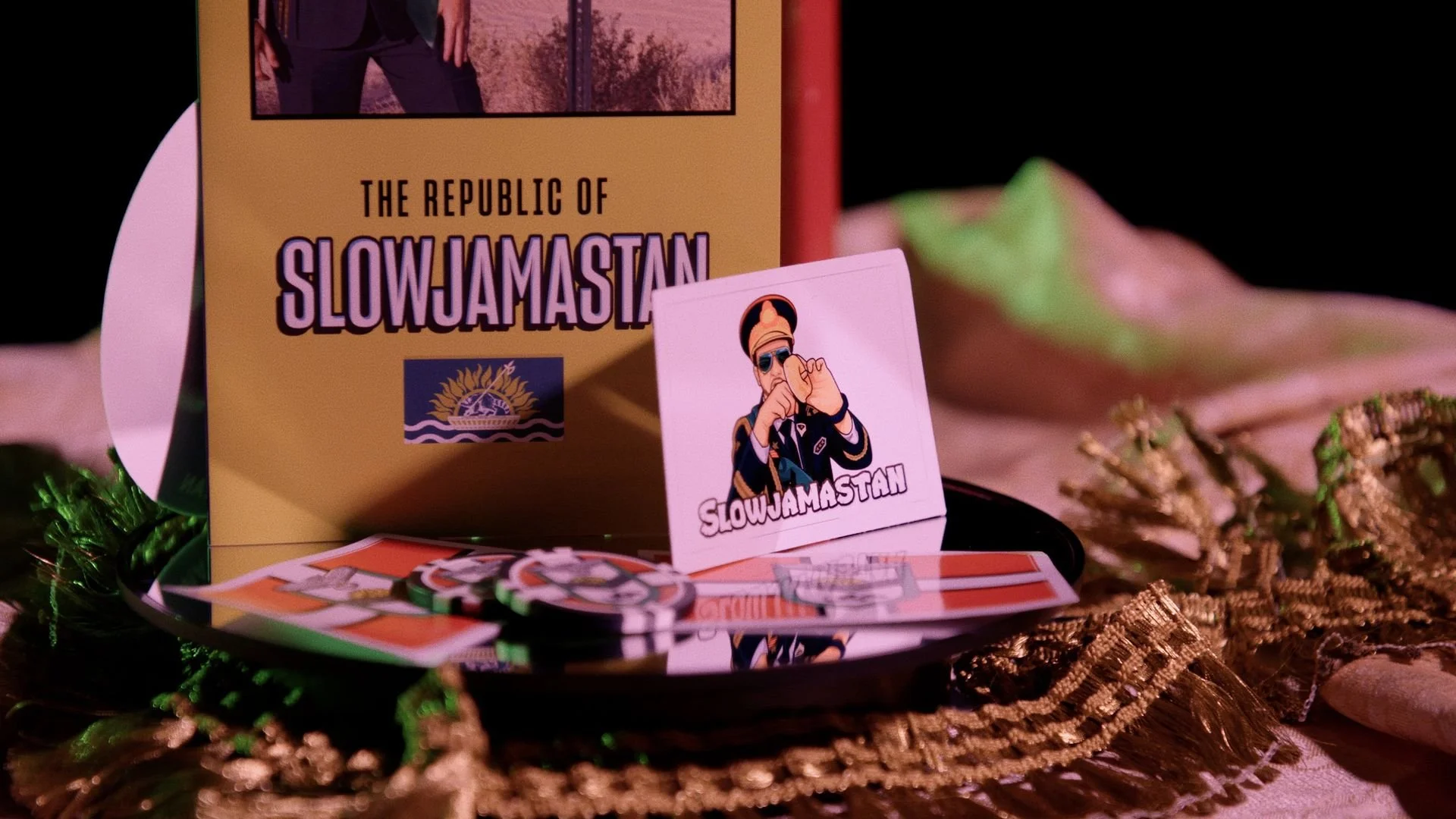
A still from Micronations.
As with so many other niche interests shared by people, the internet aided this group in discovering that there were others out there like them and in creating a common community. The film covers a micronations convention, where we’re introduced to some of the sweetest people that you’ll likely ever meet. Much like Lance Oppenheim’s wild 2024 doc Spermworld, Micronations offers a view into a community that I might never have come across otherwise, and it expanded my world ever so slightly.
**********
The movie gods – and, I’m assuming, a very perceptive festival programmer – arranged for the next screening at the Bishop Arts Theatre Center following Micronations to be a fitting companion piece, director John Spottswood Moore’s When We Were Live. Moore’s film is essentially a phantasmagoria of footage culled from hours of programming offered on Austin public access television, or AC/TV, throughout the 1980s and ‘90s.
Examining the output of one of the longest running access TV stations in the world, When We Were Live shows the yutes of today what lengths regular people would go to in order to express themselves in the days before TikTok, YouTube, or Instagram. The film follows the trajectory of several people who tried to make a career of being in front of a camera when doing so meant completely changing your life, not simply tapping an app on your phone.
When We Were Live also emphasizes the importance of a media landscape that’s not completely controlled by corporate and/or monetary interests. AC/TV documented the razing of a building that housed a mural that was extremely important to the local indigenous and Chicano communities.
**********
Because I spent the final day of OCFF 2026 at the Bishop Arts Theatre Center, I missed the other marquee repertory screening happening at the Texas. It was a screening of Tarantino’s incendiary breakout hit, Pulp Fiction, with Tarantino’s writing partner on the film, Roger Avary, in attendance. Ultimately, I’m glad I got to see When We Were Live, which overlapped with the Pulp Fiction screening. (Although I was sad to never know if the infamous N-word scene was even mentioned during the Q&A for the latter.) The other movie I saw that also conflicted with Pulp was more of a letdown.
Chronovisor, the last film I saw at OCFF 2026, was an exercise in telling, not showing. It’s a movie about a mysterious set of circumstances involving a machine which can retrieve still images, video, and sound from any point in the past. We explore this verboten machine, deliberately hidden from the public by the Catholic Church, via a woman who reads every article she can find on the topic.
Literally three-quarters of the movie is a static shot of our hero reading out of books while we’re shown what she’s reading, so that we can also read along. While the premise is fascinating – for a more intoxicating take on similar material, check out the limited series Devs, created by Alex Garland – quite frankly, Chronovisor is boring as hell. And this is coming from someone who once watched – and found enthralling – a seven-hour+ long black-and-white Hungarian art film about the effects of the breakup of the Soviet Union on a small group of villagers.
But, to bastardize a popular movie saying of yore, film festivals are like a box of chocolates, you never know what you’re gonna get. Now excuse me, while I try to figure out a way to see Shitting a Penis.
Thanks for reading.
Movies are neat.
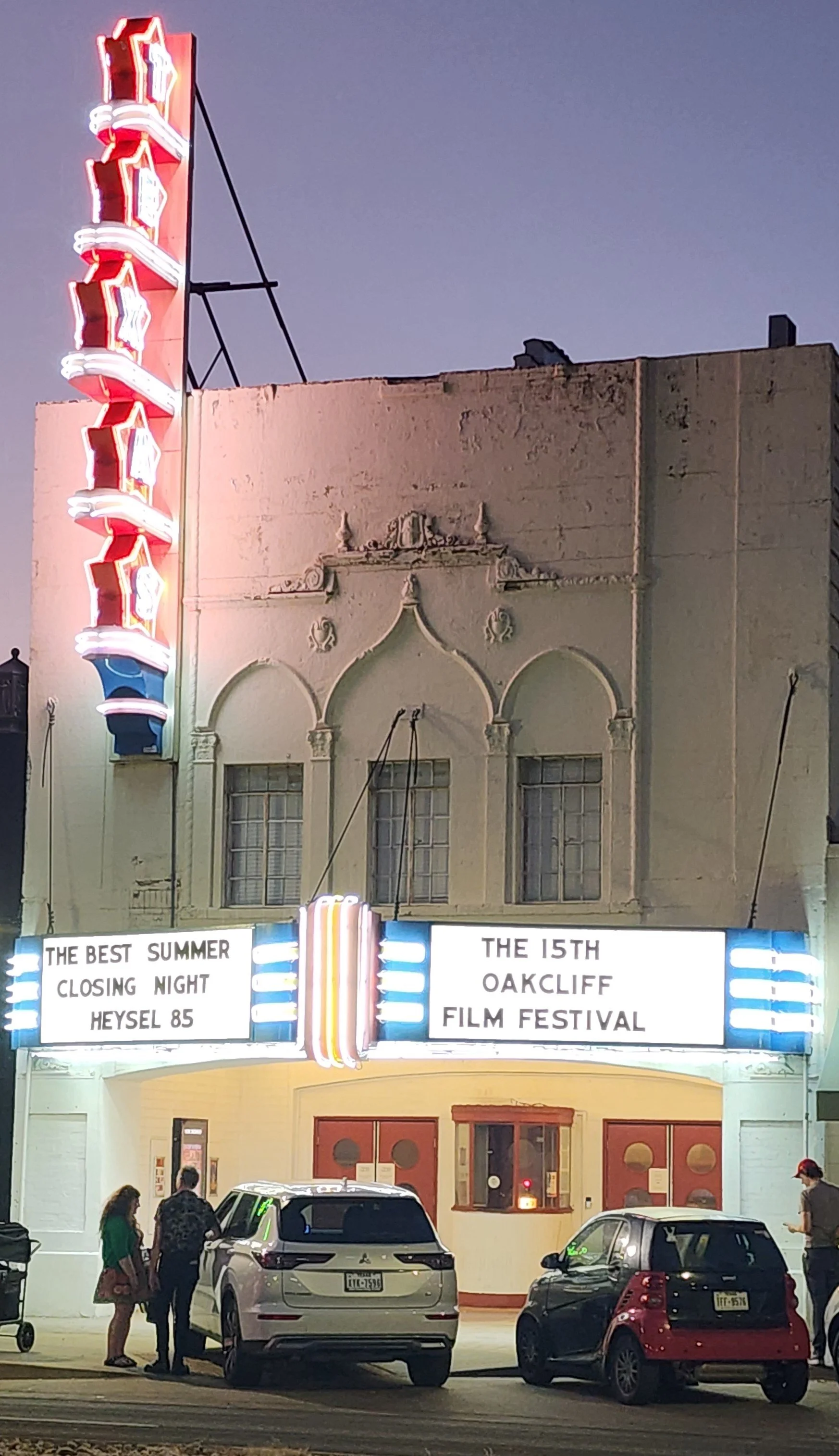
A view from the end of the fifteenth annual Oak Cliff Film Festival. (photo by the author.)