Welcome back for part two of my OCFF 2026 coverage!
**********
It’s probably no surprise that I seek out movies about critics and criticism. House of Criticism, about the married couple who also served as art critics for New York Magazine and The New York Times for decades, was one of the highlights of Tribeca 2026 for me. So, when I ran across the title The Last Critic during my preparations for OCFF 2026, I snapped up a pass. The description for the movie in the fest guide began, “Sixty years & a million records ago, Robert Christgau invented Rock music criticism.” I am Jack’s overwhelming sense of interest.
That is, however, all that I still know about this film, because I ditched the screening that night for something that excites me even more than listening to old white men talk about their opinions on art. I’m always on the hunt for avant-garde, transgressive cinema, and the late-night screening for night two of the fest sounded simply too promising to pass up.
I alerted Rae – because I thought she might be interested – and when she said she wanted to go, I knew that I had made a mistake with my original screening selection. Plus, I reasoned that the odds of me being able to see The Last Critic outside of a fest were much greater than being able to find what turned out to be an absolutely bonkers midnighter.
Cramps! A Period Piece is about one unfortunate woman’s killer endometriosis. And I don’t mean that in the way you think. While Agnes Applewhite’s excruciating menstrual pains are torturous for her, her endometriosis has a mind of its own and leaves her body to attack and kill others. This gonzo horror/comedy from first time feature director Brooke H. Cellars is a low-budget bit of DIY cinema that is as hilariously disgusting as it is gloriously campy and fresh. I mean, check out this goddamn poster:
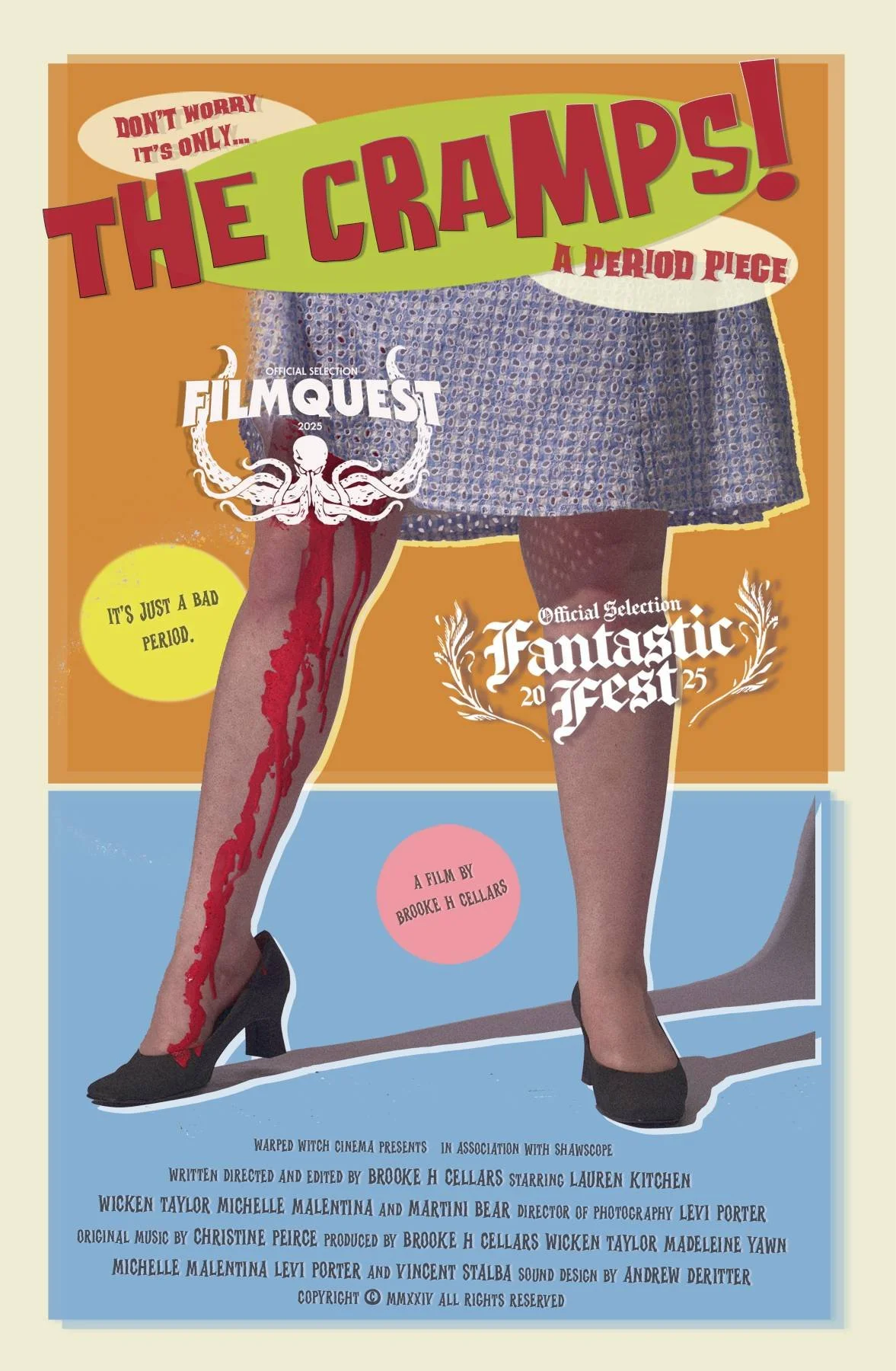
The poster for Cramps! A Period Piece.
In her post-screening Q&A remarks, Cellars let us know that her own bouts with endometriosis inspired her to make the film. When the Killer Period isn’t wreaking havoc on the local townsfolk, Cellars populates her movie with a cast of joyous outsiders making sui generis outsider art.
All Agnes wants to do is escape the clutches of her domineering mother and her cruel sister. Her dream is to work at the magical local beauty salon, run by sardonic drag queen Laverne Lancaster. Her mother lets her know, in the most histrionic terms, that Agnes working at a place like that will bring shame on the entire family. With its off-kilter, transgressive sense of humor and gross-out horror effects, Cramps! A Period Piece is Tennessee Williams by way of John Waters.
Lauren Kitchen, who plays ever-suffering Agnes, was also in attendance at the festival. She let us know that this was her first acting gig, and that she applied on a whim. Martini Bear, a real-life drag queen also making her feature debut in Cramps!, is hilarious as Laverne. With a killer period on the loose and character names like Vinyl Von Cuntley and Clydia Blackbush, I realized I had found this year’s Fucktoys as I sat in wonder watching a woman’s menstrual cycle gain agency to commit murder. The death scenes in Cramps! A Period Piece must be seen to be believed.
**********
Day three of OCFF 2026 ended up providing the most titles I would see in one day during the fest, mostly due to the one shorts block I booked for myself. The day began with an intriguing documentary that unfortunately had the stink of AI all over it.
I Got Bombed at Harvey’s tells the story of a man who, in 1980, after losing his self-made fortune to a Lake Tahoe casino as the result of a gambling addiction, devised an extortion scheme to get his money back. He designed a tamper-proof bomb, filled with a thousand pounds of TNT – one of the most fascinating things about the picture is the explanation of the design elements of the bomb – and invented an elaborate plan wherein he would plant the bomb in the casino and demand a three-million-dollar payment before delivering instructions on how to disarm it.
If you think that’s nuts, he also enlisted his two early-adult sons to help him build the bomb and carry out the extortion scheme. Underneath this thrilling true-crime tale is a story about familial abuse, coercion, and a domineering father so crazed with the thought of revenge that he threatens to ruin both his and his sons’ lives.
One of the sons is now dead, and that’s where the unfortunate decisions by the filmmakers involving AI enter the story. This man wrote a book about his experience and sat for interviews about his story long before I Got Bombed at Harvey’s was made. So, directors Amy Bandlien Storkel and Bryan Storkel used the audio from his interviews to create, with AI, the man reading portions of his book to us.
During research to write this, I discovered that at one Q&A – not for my screening; no one involved with Harvey’s was in attendance at OCFF – the filmmakers defended their use of AI, instead of paying an actor to do the voiceover work, with a tossed-off answer about how the actors they tried out simply weren’t giving them what they wanted. (I’m sure budgetary issues was the last thing on their minds.)
After a little more research, I’m now questioning if some of the re-enactment scenes for the film weren’t also generated with AI. I’m not a fan of re-enactments in documentaries in the best of circumstances – Errol Morris is the gold standard on doing re-enactments right, as far as I’m concerned – but learning that I might have been unwittingly watching a bunch of AI slop makes me throw up in my mouth a little.
And this is the problem with the current rollout of AI in the arts. Analogous to the way Donald Trump won’t end American democracy by simply canceling elections – it will be, and is being, implemented as death-by-a-thousand-cuts – the moral quandary will never be presented as a movie that’s one-hundred percent made by AI that we can then dismiss immediately. The internet laughed at Elon Musk when he said he’d make a better Odyssey using AI than Christopher Nolan’s AI-free offering. It gets a little fuzzier when the AI is used to recreate one voice or a shot here and there. It will be added, a bit at a time, to things that we would have otherwise loved until it seeps into every facet of the filmmaking process.
**********
I had signed up for the cinema 16 shorts block specifically to see one six-minute-long film. I was delighted with the other short films on offer, but I then had to miss the one movie I was there to see because my next screening was at a different venue than the one screening the shorts. I had to slip out early in order to make it to the next screening before it started.
Cinema 16 was a membership-based film society that championed avant-garde, experimental films in New York City from 1947 to 1963, with seven thousand members at the height of its popularity and influence. Amos Vogel, who created and ran cinema 16 with his wife, Marcia, was initially inspired to start the project by the works of Maya Deren. The programmers at OCFF – one in particular, whose name, sadly, I didn’t get – wanted to bring cinema 16’s aesthetic and dedication to experimental film to the fest.
The shorts block began with a four-minute film from legendary feminist and lesbian filmmaker Barbara Hammer. Her 1974 film Dyketactics is a brief, dreamy collage of nude female bodies and queer female desire, made at a time when identifying as queer could have devastating legal and social consequences.
But the reason I was there, the penultimate short of the cinema 16 block, was a film with a title so provocative that I simply had to see it. Shitting a Penis is only six minutes long, but the description in the fest guide had me beguiled by the possibilities of those six minutes:
“Found footage of a Montreal girl’s trip turns sinister as the textures and unnatural rhythms of VHS are haunted by half-remembered nightmares from the past. With Shitting a Penis, Sam Morgan transforms a found object into a dark and uncomfortable exploration of memory and identity. In an era of image overabundance, what happens to what has been recorded? Are there people trapped forever on tapes, hard drives, and phones, enshrouded mirrors of selves, caught on repeat?”
I don’t know if I’ll ever be able to track down Shitting a Penis, but missing it at OCFF 2026 was my biggest regret of the fest. The final film of cinema 16, the eight-minute Melencolia 2: Destitution Signs, also sounds like a banger: “Melencolia 2 is a polemical super 8 rant against ethnography, hipsterism, and the negation of the avant-garde due to the infiltration of milquetoast scum.” Hopefully the movie gods will see fit to make these two titles cross my path again at some point in the future.
**********
The film that caused me to dip out early from the cinema 16 screening was a documentary titled Boorman and the Devil, about the making of a movie I’ve never seen. Exorcist II: The Heretic has a reputation for its grueling, disastrous shoot and is also known, due to its campy, so-bad-it’s-good aesthetic, as one of the worst movies ever made.
Boorman and the Devil is a straightforward chronicling, with flourishes of manic energy that match the doomed production it’s detailing, of the entire process of making Exorcist II, from preproduction to the film’s lasting legacy as a historic misfire. As the title implies, we also get the story of the film’s director, who almost died during the shoot as a result of sand being whipped around a sound stage for one particular sequence in the film. (I won’t spoil exactly how; you’ll have to see the movie to find out what happened.)
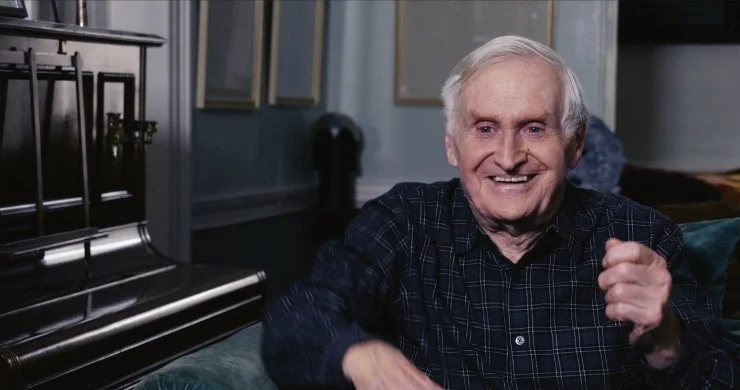
A still from Boorman and the Devil.
John Boorman made one of the most important, early-entries into the New Hollywood movement with 1967’s Point Blank; stunned and horrified viewers with Deliverance; made another all-time camp classic in Zardoz; and made one of my personal favorites, the 1981 Arthurian legend movie Excalibur. He met his match on the ill-fated Exorcist II.
Director David Kittredge includes extensive interview segments with the now-93-year-old Boorman, as well as with stars Louise Fletcher and Linda Blair. Fletcher’s reminiscences of her interactions with her other costar, the late, great Richard Burton, are priceless, as is the description of how Burton got out of participating in the table read of the screenplay, a part of the process he absolutely detested. The humor contained in Boorman and the Devil is as delightful as it is unexpected.
It also successfully salvages the reputation of the movie it’s examining. I’ve always been morbidly curious about Exorcist II. Seeing Boorman and the Devil has ensured I’ll make the time to catch up with it sooner rather than later.
**********
Check this space in a few days for the final part of my OCFF 2026 coverage.