

DIFF 2026 is the fifteenth film festival that I’ve covered for this site over the course of 3.5 years. After that much experience, I think I’ve finally become immune to the high-octane excitement that comes with a festival premiere in which a significant portion of the audience worked in some way on the movie being screened. Some of that comes down to human psychology. It sucks to be what feels like the only person in the room who isn’t into what they’re seeing. It’s easy to enjoy the high of the crowd before the movie starts; it’s a completely different vibe when the post-screening Q&A begins. When everyone in the crowd is behaving as if they just watched Ratatouille, and you feel more like you saw Ratatoing, the mockbuster made solely to sucker people who (somehow) don’t realize that this isn’t the movie they’re looking for, you can end up questioning your taste and, frankly, your sanity.
The opening night film of DIFF 2026 was certainly no Ratatoing – I’ll admit that I haven’t actually seen that 44-minute blatant ripoff of the beloved Pixar movie – but neither was it an instant classic. Last Shot is a generic sports movie amped up on melodrama and a devotion to being a capital “I” inspirational movie. If the flimsy love story on the edge of the frame were given more attention, Last Shot would feel right at home on the Lifetime Movie Network.
Director Andy Palmer’s film focuses on Caden, a tween who is passionate about playing basketball and whose father is even more passionate about his son’s budding sports career. After an opening sequence in which we see Caden’s dad flip out, sports dadzilla style, on the refs of the game and the other parents in the stands, he apologizes to Caden later that night at home.
Caden’s dad is an actor – it was a master stoke to cast professional dickhead Michael Rapaport as an alcoholic who assaults people at youth sporting events – who dies on the way to an audition in a car crash he causes while reaching for his flask that has dropped to the passenger seat floor. (This isn’t really a spoiler as it happens within the first fifteen minutes of the movie.) In the aftermath, Caden’s estranged mother, played by Jaime Pressly, begrudgingly agrees to take Caden with her back to Nashville, where she is flailing at her attempt to run her late father’s country music record label.
You can probably predict the rest of the movie from here. Caden joins a local club basketball team and confronts grief, change, and his strained relationship with his mother while learning to become part of a team on the court. Former player and two-time NBA All-star Baron Davis portrays the tough-but-fair coach of Caden’s new team. I was impressed with Davis’s acting abilities in 2023’s Joy Ride, and he continues that trend in Last Shot. Davis’s acting comes across as natural and believable.
The rest of the movie, not so much. In addition to Caden’s dead dad – the alcoholism that takes his life is never commented upon in any real way, it’s simply a plot device to get Caden where the story needs him to be – his absent, workaholic mom, and adjusting to his new team, the movie pumps up the melodramatics with various other plot machinations. Caden, naturally, develops a fledgling romance with the only girl on the team. Meanwhile, his mom is sleeping with one of her assistants, who is trying to get a singing career of his own off the ground. Each of these plot threads is more boring than the last, completely lacking in any depth.
Last Shot also has to resort to the technique of cutting around the players in the basketball sequences to hide that the actors can’t pull off the shots that we see the characters make. When we’re not on the court, we get cliché scenes like Caden’s mom being too wrapped up in getting a difficult singer’s track recorded to make it to one of her son’s games. Or it’s the assistant confronting Caden’s mom about her lack of interest in her son’s life. It’s all a very bland, uninteresting exercise.
**********
Day two of the fest offered up some more promising fare. First on the docket was a short documentary titled PALYANYTSIA. It chronicles two American artists, an always-masked guerilla-style street artist in the mold of Banksy, known to us only as Bandit, and a tattoo artist named Johnny, who see the destruction of madman Vladimir Putin’s war of aggression against the people of Ukraine and are moved to action. They coordinate a trip to the war-torn country on Russia’s southwestern border to create art on the remains of bombed out buildings and other structures with the goal of giving hope to the Ukrainian people.
In a world where most of us merely shrug our shoulders at the unconscionable cruelty in the world, it was inspiring to see two people essentially upend their lives in an effort to do something about it. Directors Kadim Tarasov and Yulia Bolshynska add fanciful moments to their film in order to highlight the determination and resolve of Ukraine in the face of Russian missile attacks. The best of these lasts only seconds. We see a young Ukrainian boy playing with his slingshot. He lets a pebble go and we see it fly off the screen before a cut shows the pebble hitting a Russian helicopter and downing it.
The film also explains to us that the word palyanytsia – the name of a Ukrainian turbojet drone developed during the war – is used in the country as a shibboleth to root out foreign agents in the Ukrainian military ranks, as Russians typically stumble over the word’s pronunciation.
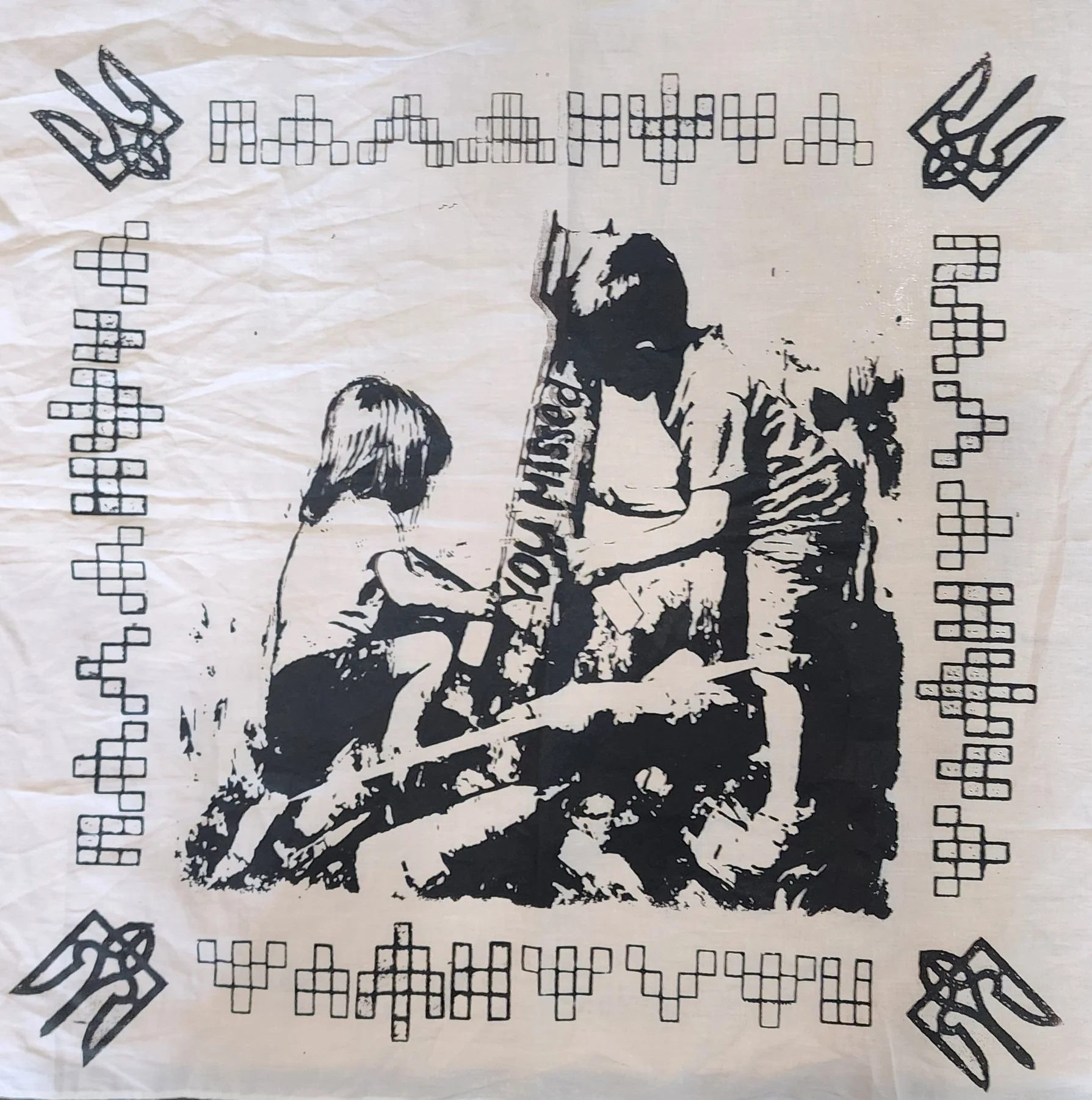
A scarf with screen-printed art similar to that seen in PALYANYTSIA (given to me by one of the filmmakers after the screening). The borders contain the word palyanytsia in code. (photo by the author)
**********
Up next was Valentina, the debut effort from director Tatti Ribeiro. Set in El Paso, Ribeiro’s film focuses on the titular character, a young Latina woman – the movie has fun with what actual Latino people think of the term Latinx – who struggles to make ends meet due to mounting parking tickets and an unstable job market.
The most intriguing thing about the movie, besides the character herself, is that Valentina fuses documentary and fiction, blurring the lines between what’s real and what was invented for the story. A line of text on the screen in the opening seconds of Valentina lets us know that virtually everything we see on the screen is real, except the character of Valentina. That meant that I was constantly curious about the circumstances of each person Valentina interacts with during the story as I watched it unfold.
Keyla Monterroso Mejia, who was hilarious as the sarcastic payday loan employee in last year’s One of Them Days, is effervescent as Valentina. Her mile-wide smile is infectious, and Mejia is effortlessly charming in the role. One of the standout moments of the movie comes when Valentina picks up a few extra bucks as a reënactor in a tourist attraction rendition of an El Paso shootout involving Billy the Kid. At 78 minutes, Valentina just misses my mark for what constitutes a feature (80 minutes), but this day-in-the-life movie about someone struggling with economic insecurity is full of empathy and humor.
**********
I started off Saturday morning of DIFF at the Virgin Hotel Dallas for the “Fireside Chat with Greg Kwedar.” While trying to find the room for the event, another attendee commented to me on the elevator ride up what a nice hotel Virgin was. I responded in the affirmative, but also mentioned that I didn’t make anywhere near enough money to stay as a paying customer. She laughed and said that neither did she.
Kwedar, a native of Fort Worth and the director of Sing Sing and the cowriter of Train Dreams, recounted during the discussion his decision to abandon the accounting degree he was pursuing at Texas A&M University to embark on a career in filmmaking. His background in accounting and marketing gave him a unique perspective on getting films made. He spoke about the novel payment structure he devised to get Sing Sing made, which I hadn’t been aware of before this conversation.
Essentially, Kwedar and his financial team took the top rate of all the unions that would be working on the film and offered it to the entire crew, from the production assistants all the way up to Sing Sing’s star, Colman Domingo. In addition, the entire crew shared in the backend profits of the movie. Kwedar is working on continuing to use this pay structure and has been asked by other filmmakers about implementing it on more films. There’s a word for this kind of pay equality, but I can’t think of it at the moment. That’s probably for the best, as I don’t want to end up on any blacklists.
**********
I was only able to squeeze in three movies the rest of the weekend, and I missed one of my most anticipated screenings, Kim Novak’s Vertigo, because of my devotion to seeing as many episodes of Twin Peaks on the big screen as possible. Regular readers know that the Texas Theatre began screening all three seasons (although they skipped the back-half of season two) of David Lynch’s magnum opus back in January. I had to skip the last movie during my coverage of the Denton Black Film Festival in order to make it to one of these weekly screenings of Twin Peaks. Hopefully, I’ll have a chance to see Kim Novak’s Vertigo at a festival down the road. I have some exciting news on that front that you’ll read more about in a few months…
Among the weekend’s offerings that I was able to attend was an extraordinary documentary featuring Jane Fonda called Gaslit. The film focuses on the boom in liquified natural gas (LNG) production in the US. The increased production of what is essentially methane gas (one interview subject expresses her frustration at the deceptive term “natural”) is having devastating effects on the environment and especially the people living in zones made toxic by the LNG facilities located along the gulf coast areas of Texas and Louisiana.
Fonda’s trip through “cancer alley” and the so-called “sacrifice zones” of these facilities, where she talks to everyday people – who are mostly poor, as the fossil fuel industry picks fights with people who can’t fight back – is equal parts enraging and devastating. Fonda brings along a few famous friends, actor Connie Britton and singer/songwriter Maggie Rogers, for parts of the trip. Those segments, which are ultimately unnecessary to the overall story of Gaslit, are one of the few faults in a film that is trying to raise awareness and build a coalition to fight the sick and destructive oil industry.

A still from Gaslit.
**********
I concluded Sunday night with another documentary. Revolution’s Daughter chronicles the lives of several refugees from the Fidel Castro regime in Cuba, including among them Gloria Estefan and Castro’s own daughter, Alina Fernández Revuelta, who escaped from Cuba in 1993. The film does an incredible job of making us understand the terror inflicted on Cubans by the authoritarian Cuban regime and the deep sadness of those who escaped, but ultimately wish to return and live in a free Cuba.
However, Revolution’s Daughter also devolves into anti-communist propaganda and a willful misunderstanding of history. Included in the film are warnings from Estefan and the other interview subjects about the fragility of democracy and how easily it can be overthrown by an authoritarian regime. These warnings come across as mealymouthed and toothless because not one of them mention that Donald Trump is the danger to democracy we should currently be fearing. I’m guessing that’s a function of Republicans’ alignment with the anti-communist Cuban cause, who are most likely a key demographic that the filmmakers are trying to reach.
The doc also takes great pains to illuminate the deprivation experienced by the current Cuban population. It attempts to lay this deprivation solely at the feet of the Cuban regime without ever acknowledging the role that US policy toward the island nation has played in keeping everyday Cubans hungry, cold, and isolated from the world.
The interview subjects speak about how Castro cut off his country from the global community, but at no point does the movie address the fact that the US has implemented a brutal trade embargo on the people of Cuba since the 1959 revolution, severely exacerbating their lack of resources.
Nor does it mention that a major factor in Castro’s revolution was the US’s support of the Batista military dictatorship, in which Cuba was treated as a resort for the wealthy of the world (particularly those of the US) while the country’s poor were left to fend for themselves.
The most disturbing part of the event was the post-screening Q&A. Revuelta, Castro’s daughter, was in attendance and when the moderator asked if she thought the US should do something to free the people of Cuba, she responded that a “little outside push” helped the revolution in 1959 happen, and that maybe “another little push” was needed to end it.
Considering that the current US president has already illegally invaded Venezuela, in order to abduct their president; is waging an illegal, offensive, and immoral war in Iran; and, as a matter of fact, is currently causing mass starvation and blackouts affecting the everyday Cubans that Revolution’s Daughter claims to care about, I can’t possibly think what might go wrong.
During the Q&A, someone in the audience yelled out, “THE TIME IS NOW,” in response to Revuelta’s call for that “little push.” It’s funny how easily some people will call for death, destruction, and suffering from their comfy seat in a movie theater. I was tempted to call out in response, “Finish your thought, big boy. What’s it time for, another illegal, immoral war of aggression that will include more war crimes and crimes against humanity?” It was a really depressing cap to the weekend.
I’m publishing this report from the field a little later than intended. It’s going up on the last day of the fest, but I’ll be back, hopefully in about a week, to recap the second half of my DIFF 2026 adventures.
Onward!