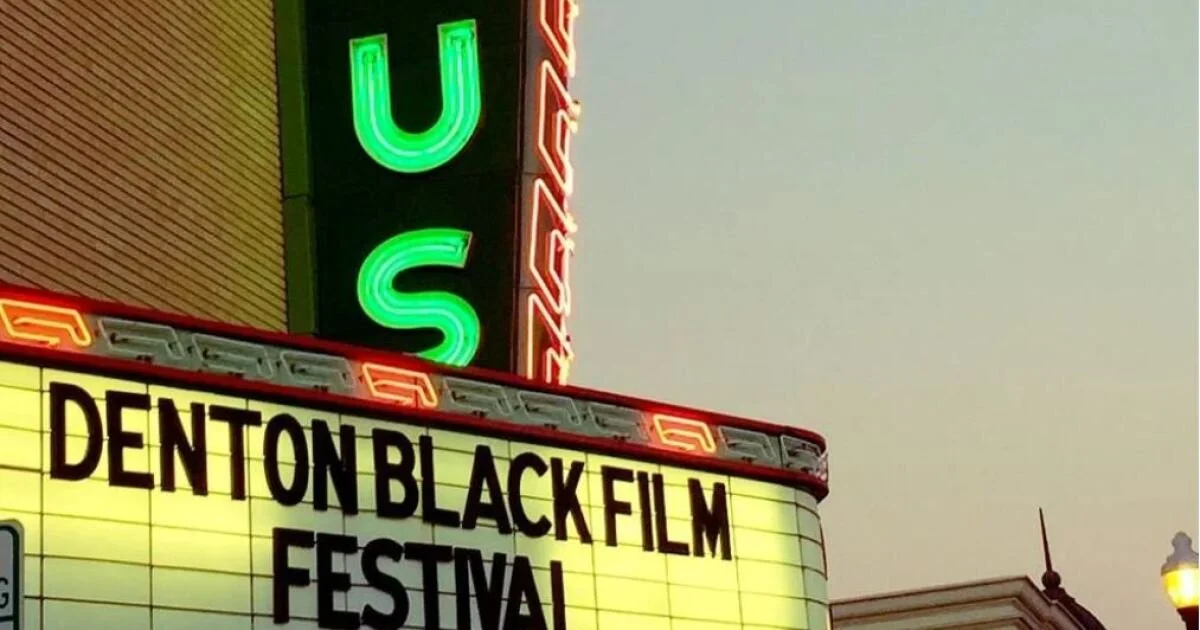
Welcome to the first part of my coverage of the Denton Black Film Festival, 2026 Edition. The fest was held January 28 through February 1, and extended virtually from the first through February eighth.
Thursday, Opening Night
Quakertown USA, the documentary featured as the opening night screening for the 2026 Denton Black Film Festival, proved to be a study in contradictions for me. This labor of love, from codirectors King Hollis and Lindell Singleton, explores a vitally important and shameful part of Texas and US history. It fails, however, to capture that history in a compelling way.
What happened to the people of Quakertown – a freedmen’s community settled within Denton, Texas in the 1800s – in 1921 was a blatant injustice and a racially motivated way for the elites in Denton to enrich themselves at the expense of the city’s Black residents.
The forced removal of the Quakertown citizens, who built a thriving and peaceful community, is a story all too familiar to the diaspora of Black Americans whose recent ancestors were pushed off of their land in the name of so called “progress.”
The Tulsa race massacre, also perpetrated in 1921, is probably the most violent example of this phenomenon, which has occurred countless times in our nation’s history, and, indeed, continues to happen, only now under sanitized names like “gentrification” or “urban renewal.” In Tulsa, a white mob murdered the residents of what was popularly known at the time as “Black Wall Street,” in an effort to keep their fellow human beings subjugated with the use of terror.
Quakertown – which was named to honor the members of that religious sect who helped formerly enslaved people during Reconstruction – was dismantled bloodlessly, but that doesn’t mean that the trauma and injustice suffered by the victims was any less real. Through a bond election, eminent domain, and unchecked bigotry, the land on which the Quaker community sat was seized by the white elite of Denton in order to create a city park.
Part of the reasoning was because the white women attending the college now known as Texas Women’s University had to walk through Quakertown to get to downtown Denton. A local politician wanted potentially-lucrative accreditation for the school as well, and he convinced the white community that the school’s proximity to a Black community was hindering that goal.
Hollis and Singleton’s film documents this vital history, but the final result leaves a lot to be desired. They use one of my least-favorite documentary techniques, the reenactment. We see a scene of a woman trying to get reassurance that her deed guarantees that her land can’t be taken from her. Another shows us the white Denton elite discussing the plan to dismantle Quakertown. Each of these vignettes are poorly acted and don’t give us much insight beyond what the picture’s narration already tells us.
Also, I can’t be 100% sure – audience questions weren’t solicited during the post-screening Q&A – but I’m fairly confident that AI was used liberally to pad Quakertown USA’s 74-minute runtime. I saw a fluttery eyelid at one point, and several other passages of the film have that AI-slop uncanniness that, hopefully, we’ve all come to recognize. I stopped counting at six instances of what I suspected was AI generated content. While they only lasted seconds at a stretch, every instance was noticeable and disconcerting. I understand that Quakertown USA had a very limited budget, which makes me inclined to look the other way, but the AI threat to creative talent is a serious one that we can’t ignore.
The use of the (suspected) AI scenes and the reenactments were probably attempts by the filmmakers to break up the nonstop talking-head interview style of the rest of the documentary, to limited success. Quakertown USA chronicles a dark chapter in US history – one that has dozens, if not hundreds, of other examples – that white power structures want forgotten. While it doesn’t succeed at compelling storytelling, the film helps keep that history alive, while also spotlighting the resilience, hope, and courage of those left in its wake.
Friday
I settled into my seat at the Campus Theater for my first full day of screenings. First up was a collection of shorts grouped under the title Becoming Ourselves. The audience responded most enthusiastically – based on how many people wanted to comment on it during the Q&A – to a short named The Shine King. It’s an infectiously entertaining 17-minute film about a man who practices a trade that is slowly fading from society: shoe shining. Larry Ellis has been shining shoes in Arkansas for over half-a-century, and he’s still as in love with the process as he was when he first discovered it.
The filmmaking itself is rather roughshod. There are editing decisions that place two interview segments with Ellis, filmed in completely different locations, back-to-back, which is a rather bewildering experience. Still, Ellis is so in love with his chosen profession that I couldn’t help but smile as he waxed eloquent about the shoe shine trade. Several of the audience members commented after the screening about how important shoe shining has been to the Black community and how much they enjoyed hearing Ellis’s story.
The highlight of Becoming Ourselves for me was the short Futures Without Guns, from director Kyra Knox. This 30-minute short details an art installation curated by Angela McQuillan at The College of New Jersey. McQuillan invited nine artists working in different mediums to envision a future devoid of the senseless violence, death, and pain caused in our society by guns.
Knox focuses on three of the artists and their process and final pieces for the exhibition. The most stunning work of the three comes from artist Mikael Owunna, who uses fluorescent black-light body paint to give an ethereal holiness to the human form. It feels like we’re millennia away from ever achieving a society that isn’t awash in instruments of death, but we’ll only ever get there if we can first envision that future for ourselves. Knox’s film is a step towards that goal.
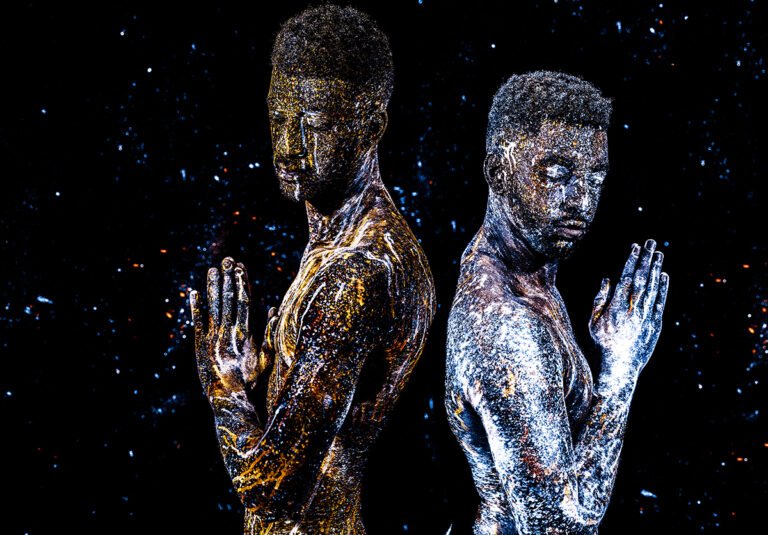
Original artwork, titled “Prayers Answered”, from Mikael Owunna, as featured in Futures Without Guns.
**********
Next up was a mind-bending ode to filmmaking from Atlanta-based codirectors/screenwriters John Dierre and Ryan Dutter. Meta Take One, as the title implies, is a trippy meditation on what happens when a filmmaker’s aspirations of finishing a movie becomes an all-consuming obsession. Dierre and Dutter’s cheekiness is on display right up front in the film’s opening minutes. We’re introduced to a group gearing themselves up for what we think is a robbery. The dialog and energy of the scene evoke a heist movie. As they rush into the building that they’ve set their sights on, we realize they aren’t Heat-style bank robbers, they’re filmmakers on the first day of the shoot.
Using a borrowed convenience store as a location, things take a dark turn when the principal actor uses a prop gun, which is loaded with real bullets, on a security guard who wasn’t notified about that night’s shoot. The crew panics and the director, John, herds them away from the location, lest a report of the incident and the ensuing investigation bring a halt to his dream of finishing his movie. From there, Meta Take One continually blurs the line between fantasy and reality as John does whatever he can to complete his movie, his tenuous grasp on sanity notwithstanding.
Actor EJ Ezeruo portrays John with a fevered intensity that made me believe whole heartedly in the character’s all-consuming fixation. Ernest Emmanuel Peeples, as Damon, John’s lead actor, is every bit as twitchy as his counterpart. The ever-increasingly absurd situations that Damon finds himself in, after the two characters are forced to split up to avoid capture, are the most comical thing about Meta Take One.
The whole movie is a fever dream reminiscent of Scorsese’s After Hours. I was disappointed when Dierre and Dutter’s post-screening Q&A didn’t materialize. I would have loved to ask some questions about the length and difficulty of the low-budget shoot. I walked away from Meta Take One wanting desperately to see what these guys could do with a five-million-dollar budget.
**********
My last screening of the day at the Campus Theater was a double feature of director Jamila Wignot’s HBO documentary series Stax: Soulsville USA, about the formation and history of the Stax recording studio and label. Based in Memphis, Stax Records produced some of the most iconic soul music of the early rock-and-roll era from performers like Sam & Dave, Booker T. & the M.G.’s, and Otis Redding. (I was somehow ignorant, until now, about the tragic death of Redding and how it related to the release of his plaintive hit, (Sittin' On) The Dock of the Bay. That history gives the song even more poignancy than it already had for me.)
After the screening of the first two episodes of her four-part series, director Wignot advised us that the second half of her opus isn’t nearly as inspiring as the first. She talked about how the reaction to those first two episodes is always centered around the positivity of the multi-racial project that was Stax. Things apparently aren’t so warm and fuzzy in the second half. I’ll make a priority to fire up the HBO Max app in the next week or so to finish it up and find out for myself.
**********
I made my way the couple of miles up the road to DBFF’s other primary venue, Alamo Drafthouse Denton, for the last screening of the day. It was a documentary called Enongo, about rapper, producer, and Ph.D. candidate Enongo Lumumba-Kasongo, also known by her Metroid-inspired stage name, Sammus. Lumumba-Kasongo fuses nerdcore and social justice into intoxicating rhymes backed up by entrancing beats. Director Kevin Schreck follows the artist as she cultivates an underground following on the road during a tour, while simultaneously working on her Ph.D. and teaching at the collegiate level.
Lumumba-Kasongo bares her soul numerous times throughout the documentary. Her story of being a Black woman trying to find her way in a white-dominated culture and society is both inspiring and, at times, heartbreaking. The animated sequences – notably created by the first all-Black women animation team – added artistic beauty to a tale overflowing with it.
When I got back to my lodgings for the weekend – my friends, the Headdens, graciously opened their home to me while I was covering the fest – I was swiftly reminded of how uncool I am (and probably always will be). I was filling in one of my hosts on what I had seen during the day, and when I got to Enongo, he let me know that, not only was he aware of this brand-new-to-me artist, but that he had seen Sammus in concert. I am Jack’s constant sense of uncoolness.
**********
Check back tomorrow for the last part of my DBFF 2026 coverage.